Medical associations demand compliance in radiology reporting services
By Aloys Michael, June 12, 2026The Kenya Association of Radiologists (KAR) and the Kenya Medical Association (KMA) have called on hospitals, imaging centres, healthcare providers and digital health companies to ensure full compliance with Kenyan laws governing radiology reporting services.
In a joint position statement issued on Friday, June 12, 2026, the two medical bodies said the call follows a recent High Court ruling that reaffirmed the need for radiology reporting to be conducted within the country’s regulatory framework to protect patient safety and uphold professional standards.
“Radiology reporting is a specialised medical service that must be undertaken within the established regulatory framework to safeguard patient safety, confidentiality, professional accountability, and quality healthcare delivery,” the statement read in part.
According to KAR and KMA, the court ruling also resulted in the suspension of the operations of Rology Medical Kenya Limited pending compliance with requirements set by the Kenya Medical Practitioners and Dentists Council (KMPDC), the Data Protection Act, the Digital Health Act and other applicable healthcare regulations.
The associations urged healthcare facilities engaging local or foreign teleradiology providers to ensure that all medical images are interpreted and reported by qualified specialist radiologists who are registered and licensed by KMPDC.
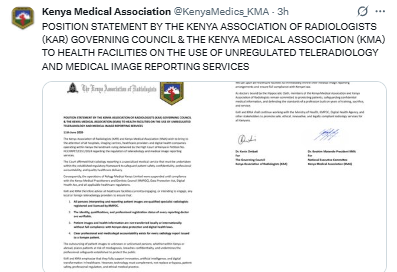
They further said hospitals must be able to verify the identity, qualifications and professional registration status of every doctor issuing radiology reports.
Facilities were also advised to ensure that patient images and health information are not transferred within or outside the country without full compliance with Kenya’s data protection and digital health laws.
In addition, KAR and KMA stressed the need for clear professional and medicolegal accountability for every radiology report issued to Kenyan patients.
“The outsourcing of patient images to unknown or unlicensed persons, whether within Kenya or abroad, places patients at risk of misdiagnosis, breaches confidentiality, and undermines the professional safeguards established to protect the public,” the statement said.
The associations said Kenyan radiologists undergo extensive specialist training, licensing, continuous professional development and regulatory oversight before being entrusted with patient care.
They argued that any individual or organisation providing similar services to Kenyan patients should be held to the same standards.
KAR and KMA also emphasised that they support innovation, artificial intelligence and digital transformation in healthcare.
However, they noted that technology must complement, not replace or bypass, patient safety, professional regulation, and ethical medical practice.
The two organisations called on healthcare facilities to immediately review their medical image reporting arrangements and ensure full compliance with Kenyan law.