Advertisement
MCK orders mandatory 7-second delay for all live broadcasts to curb hate speech
Tuesday 24th March, 2026 12:56 PM|

The Media Council of Kenya (MCK) has issued an advisory to all media houses, mandating the implementation of a minimum seven-second delay for all live broadcasts.
The directive, released on Tuesday, March 24, 2026, aims to curb the unintended publication of material that violates the national Code of Conduct for Media Practice.
The council expressed concern over the rising trend of unchecked live coverage, particularly during political rallies and public gatherings.
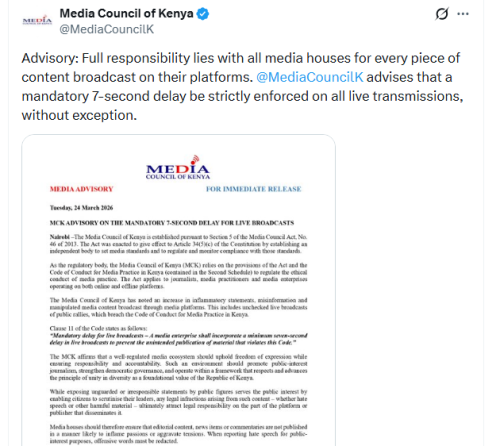
The notice stated that the council has noted an increase in inflammatory statements, misinformation, and manipulated media content broadcast through media platforms.
You Might Also Like


According to the MCK, such broadcasts have frequently breached the Code of Conduct for Media Practice in Kenya.
“This includes unchecked live broadcasts of public rallies, which breach the Code of Conduct for Media Practice in Kenya. A media enterprise shall incorporate a minimum seven-second delay in live broadcasts to prevent the unintended publication of material that violates this Code,” MCK noted.
Accountability for Media Houses
The Council clarified that although media houses are not responsible for the initial utterances made at political rallies or public gatherings, those remarks become subject to media regulations the moment they are transmitted via a media platform.
“Although the MCK and the media sector are not responsible for utterances made at political rallies or other public gatherings, once such remarks are transmitted via a media platform, they become subject to media regulations,” MCK stated.
The MCK affirms that a well-regulated media ecosystem should uphold freedom of expression while ensuring responsibility and accountability.
Redact offensive words
Such an environment should promote public-interest journalism, strengthen democratic governance, and operate within a framework that respects and advances the principle of unity in diversity as a foundational value of the Republic of Kenya.
Broadcasters are expected to redact offensive words, even when reporting on hate speech for public-interest purposes, to avoid inflaming passions or aggravating tensions.
“Media houses should therefore ensure that editorial content, news items or commentaries are not published in a manner likely to inflame passions or aggravate tensions. When reporting hate speech for public-interest purposes, offensive words must be redacted,” MCK stated.
Author
Emmanuel Rono
Rono is a dynamic digital journalist with a proven track record in newsroom leadership and content creation. Currently a Digital Writer for People Daily Digital, Emmanuel’s career is rooted in a lifelong passion for storytelling.
View all posts by Emmanuel RonoLatest News







Advertisement
More on News