Mbadi: Kenya’s economy posts 5.2% growth amid protests and global headwinds
By Aloys Michael, June 27, 2025The Cabinet Secretary for the Treasury, John Mbadi, reveals that Kenya’s economy has demonstrated remarkable resilience amid protests, flooding, and mounting external pressures, recording an average growth of 5.2 per cent over the past two years.
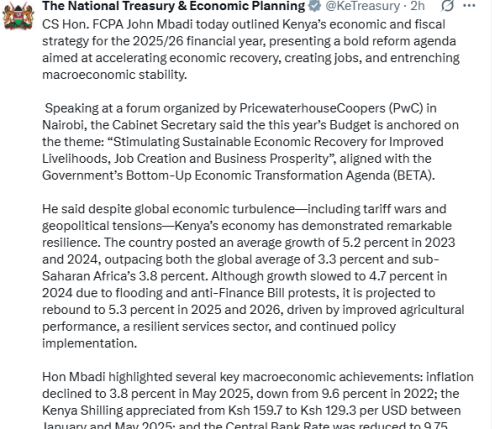
Speaking at a forum organised by PricewaterhouseCoopers (PwC) in Nairobi on Friday, June 27, 2025, Mbadi outlined the government’s bold economic and fiscal strategy for the 2025/26 financial year, which aims to accelerate recovery, job creation, and fiscal stability.
“Kenya’s economy posted an average growth of 5.2 per cent in 2023 and 2024, outpacing the global average of 3.3 per cent and sub-Saharan Africa’s 3.8 per cent,” Mbadi announced.
While acknowledging a slowdown to 4.7 per cent growth in 2024—attributable largely to adverse flooding and protests against the Finance Bill—he remained optimistic about the future.
“The economy is forecast to rebound to a strong 5.3 per cent in both 2025 and 2026,” he stated, highlighting the improved performance of agriculture, the resilience of the services sector, and continued government policy implementation as key drivers of growth.
The CS emphasised that these achievements come despite significant external headwinds, including global tariff conflicts and geopolitical tensions, which continue to impact trade and investment flows.
“Our government is intentional about tackling these issues head-on to realise its goals,” Mbadi assured, reflecting a determined commitment to sustained economic progress.
A major highlight of Mbadi’s presentation was the government’s theme for the upcoming budget: “Stimulating Sustainable Economic Recovery for Improved Livelihoods, Job Creation and Business Prosperity.”
The theme he said underscores the administration’s focus on inclusive growth aimed at empowering grassroots communities and expanding opportunities across the country.
Future of Kenya economy?
Mbadi also presented several positive macroeconomic indicators that strengthened Kenya’s financial outlook. Inflation has dropped from a high of 9.6 per cent in 2022 to a more manageable 3.8 per cent as of May 2025, while the Kenya Shilling has appreciated significantly against the US dollar—from Ksh159.7 to Ksh129.3 within five months. Additionally, the Central Bank Rate was lowered to 9.75 per cent, easing borrowing costs for both businesses and consumers.
Further financial stability is evident in falling Treasury bill and commercial lending rates, an increase in foreign exchange reserves to a robust about Ksh1.36 trillion (covering 4.7 months of imports), and a historic narrowing of the current account deficit to just 1.3 per cent of GDP.
“These improvements signal stronger external balances and better economic fundamentals,” Mbadi noted.
However, he did not shy away from the challenges ahead.
“We face rising spending demands, shrinking debt space, and the urgent need to raise domestic revenues without burdening businesses,” Mbadi cautioned.
He said to navigate the fiscal constraints, the government plans a “growth-oriented fiscal consolidation strategy,” targeting a reduction of the budget deficit from 5.3 per cent in FY 2023/24 to 4.8 per cent in FY 2025/26, and further down to 2.7 per cent by FY 2028/29.
Mbadi detailed the government’s two-pronged reform agenda: on revenue, the Kenya Revenue Authority (KRA) is rolling out digital innovations to improve tax compliance and collection efficiency.
“Initiatives such as populated VAT returns, simplified PAYE platforms, an electronic rental income system, and fuel-sector e-invoicing will streamline the taxpayer experience,” he explained.
On the expenditure front, the government will introduce full-scale e-procurement across all Ministries, Departments, and Agencies from July 1, 2025. Complementary reforms include digitizing pension management, adopting zero-based budgeting, implementing a Treasury Single Account, and transitioning to accrual-based accounting—all designed to enhance transparency, accountability, and efficiency.
Tackling the challenge
Mbadi also expressed concern over the recent freeze on donor funding by the United States government, which threatens over Ksh33 billion allocated to crucial health programs from partners such as USAID, PEPFAR, and the Global Fund.
“We are committed to safeguarding these programmes by mobilising more domestic resources and reprioritising spending,” he emphasised, underscoring the government’s resolve to protect vital social services.
Reaffirming the critical role of the private sector, Mbadi stated, “Our national development journey cannot be driven by Government alone. The private sector is indispensable in driving innovation, creating jobs, and building an economy that works for all.”
He pledged continued government support through regulatory reforms, digital service delivery, and predictable policy frameworks to create a conducive business environment.
Mbadi expressed confidence that the 2025/26 Budget will restore fiscal sustainability, protect livelihoods, and accelerate Kenya’s economic transformation.
“This comprehensive strategy reflects a steadfast commitment to inclusive growth and shared prosperity,” he asserted.
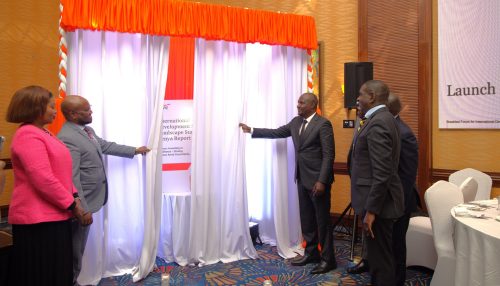
The forum also saw the launch of the International Development Sector Landscape Survey – Kenya Report, highlighting Kenya’s expanding collaboration with global development partners as the nation charts a resilient path to recovery and prosperity.