Advertisement
Majority of Kenya feel the country is headed in the wrong direction – Infotrak
Thursday 25th September, 2025 03:13 PM|

The majority of Kenyans believe the country is heading in the wrong direction, according to an Infotrak poll conducted on August 13–14, 2025.
The survey sampled 2,400 adult Kenyans across all 47 counties and eight regions using Computer Assisted Telephone Interviews (CATI).
Also Watch: Support for Ruto-Raila broad-based govt increases by 7 per cent – TIFA.
With a ±2 per cent margin of error at a 95 per cent confidence level and a 96 per cent response rate, the data was weighted for demographic accuracy based on the 2019 Census and analysed using SPSS 27.
You Might Also Like



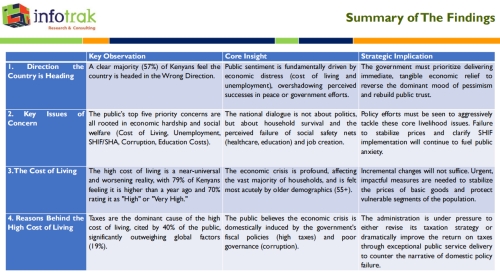
“A clear majority (57%) of Kenyans feel the country is headed in the wrong direction,” read the report dated September 25, 2025.
Economic distress drives pessimism
According to the report, public sentiment is fundamentally driven by economic distress, with the high cost of living and unemployment overshadowing perceived successes in peace or government efforts.
The top five public concerns – cost of living, unemployment, Social Health Insurance Fund (SHIF/SHA), corruption, and education costs – reflect a focus on household survival rather than politics. Infotrak notes that the national dialogue is no longer about politics but about the perceived failure of social safety nets such as healthcare, education and job creation.
“The public’s top five priority concerns are all rooted in economic hardship and social welfare (cost of living, unemployment, SHIF/SHA, corruption, and education costs).”
Rising cost of living
The cost of living remains a pressing issue, with 79 percent of respondents reporting it is higher than last year and 70 percent rating it as “high” or “very high”. Older Kenyans, especially those aged 55 years and above, feel this burden most acutely.
The report highlights that the economic crisis is profound, affecting the vast majority of households and is felt most by older demographics. Taxes are identified as the primary cause of the high cost of living, cited by 40 percent of respondents, compared to 19 percent pointing to global factors.
Infotrak explains that the public believes the economic crisis is domestically induced by the government’s fiscal policies, including high taxes, and poor governance, such as corruption.
Call for immediate action
The report urges immediate action to address these concerns.
It advises that the government must prioritise delivering immediate and tangible economic relief to reverse the dominant mood of pessimism and rebuild public trust. It also calls for aggressive policies to stabilise prices and clarify SHIF implementation, warning that failure to stabilise prices and clarify SHIF implementation will continue to fuel public anxiety.
“The administration is under pressure to either revise its taxation strategy or dramatically improve the return on taxes through exceptional public service delivery to counter the narrative of domestic policy failure.”
Author
Latest News








Advertisement
More on News