Advertisement
Madaraka Day 2026: Inside the billions used to turn Wajir into national showpiece
Monday 01st June, 2026 08:27 AM|

The decision to host the 2026 Madaraka Day celebrations in Wajir County has triggered one of the most ambitious government-driven infrastructure transformations in northern Kenya in recent years, with more than Ksh2 billion injected into roads, public facilities, transport systems, and urban upgrades ahead of the national event.
According to Interior Principal Secretary Raymond Omollo, the investments were part of a broader strategy to not only prepare Wajir for hosting dignitaries and national celebrations but also to create long-term economic and social value for residents long after the festivities conclude.
Massive road network overhaul
A significant portion of the funds, about Ksh1.9 billion, was allocated to road construction and rehabilitation under the Kenya Urban Roads Authority (KURA).
The programme delivered 25.1 kilometres of upgraded and newly constructed roads within Wajir town and its surrounding areas.
You Might Also Like
Key projects include Furaha Girls–Wajir Stadium Road, A2–Manyalo Junction and Stadium Ring Road, and access roads to the County Commissioner’s residence, police headquarters, affordable housing units, and the Wajir Museum.
“The government’s flagship Madaraka projects in Wajir County include six critical road projects implemented by the Kenya Urban Roads Authority at a cost of Ksh1.9 billion. The road projects cover 25.1 kilometres of newly constructed and rehabilitated roads in and around Wajir town. The Furaha Girls – Wajir Stadium Road and the A2 – Manyalo Junction and Stadium Ring Road provide direct access to the stadium. The access roads to the County Commissioner’s residence, affordable housing units, County Police Commander’s offices, Wajir Museum and Police Quarters unlock key government and residential facilities,” PS Omollo said in a briefing published on May 30, 2026.
These roads are expected to improve connectivity between key public institutions and residential zones while easing movement during and after the celebrations.
A major highlight is the 9-kilometre Airport–Basabra–Furaha School–Stadium Link Road, designed to enhance mobility from Wajir Airport to the main celebration venue.
Industrial park link to boost trade
Another critical project is the Access Road to the Wajir County Aggregated Industrial Park.
Officials say the road is expected to significantly reduce the cost of doing business by linking the industrial zone directly to the town’s road network, effectively positioning Wajir as a future manufacturing and logistics hub in northern Kenya.
Flood control and CBD improvements
PS Omollo said the B13 Miyale Road Drainage Enhancement Project has also been completed, targeting persistent flooding challenges in the Central Business District.
The project is expected to improve accessibility to key government offices, including the County Assembly, while enhancing resilience against seasonal flooding that has historically disrupted business activities in the town.
New stadium and sports infrastructure
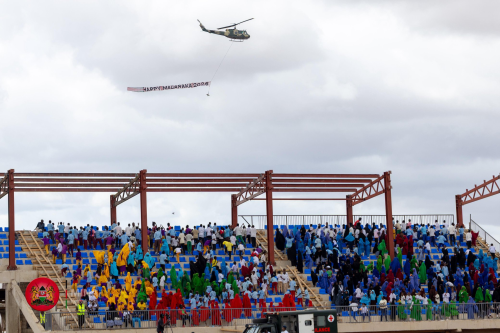
As part of the Madaraka Day legacy projects, the government constructed a new 10,000-seat Wajir Stadium equipped with a VIP pavilion, football pitch, athletics track, and parking facilities.
The stadium is expected to serve as a permanent sports and community facility, promoting youth engagement and talent development in the region.
Airport and security upgrades
Wajir Airport also underwent significant improvements, including resurfacing of the 1.2-kilometre runway and rehabilitation of access roads.
Authorities say the upgrade will improve regional connectivity, facilitate trade, strengthen humanitarian logistics, and attract future investment into the county.
In addition, the State Department for Internal Security refurbished the Wajir County Commissioner’s residence, including landscaping, perimeter security installations, CCTV systems, and external works.
Street lighting installations across Wajir town have also improved nighttime safety and boosted small business activity.
Government estimates indicate that more than 700 local workers were employed during the construction phase, injecting income into households and stimulating local economic activity.
Officials say the infrastructure projects will reduce transport costs, improve access to essential services, and strengthen Wajir’s position as a growing urban centre in northern Kenya.
While the upgrades were initiated to support the 2026 Madaraka Day celebrations, officials emphasise that the investments are designed as long-term development assets rather than temporary event infrastructure.
The model of rotational hosting of national celebrations has increasingly been used by the government as a tool for equitable development, ensuring that counties hosting national events benefit from sustained infrastructure investment.
This year’s Madaraka Day celebrations are anchored on the theme: Education: Skills and the Future, highlighting the importance of human capital development in driving Kenya’s long-term economic transformation.
Author
Mustafa Juma
View all posts by Mustafa JumaLatest News







Advertisement
More on News