LSK boss Kanjama welcomes court freeze on new NTSA inspection rules for private vehicles
By Sharon Atieno, July 2, 2026Law Society of Kenya Charles Kanjama has welcomed the High Court decision temporarily suspending the enforcement of the controversial new private vehicle inspection regulations introduced by National Transport and Safety Authority, terming the move a major relief for millions of Kenyan motorists.
Speaking through his official X account on Thursday, July 2, 2026, the Law Society of Kenya President said the conservatory orders issued by the court were a timely intervention against regulations that had raised constitutional concerns.
“The Law Society of Kenya welcomes the timely High Court directive temporarily suspending the enforcement of the new Traffic (Motor Vehicle Inspection) Rules, 2026, as they apply to private non-commercial vehicles,” Kanjama stated.
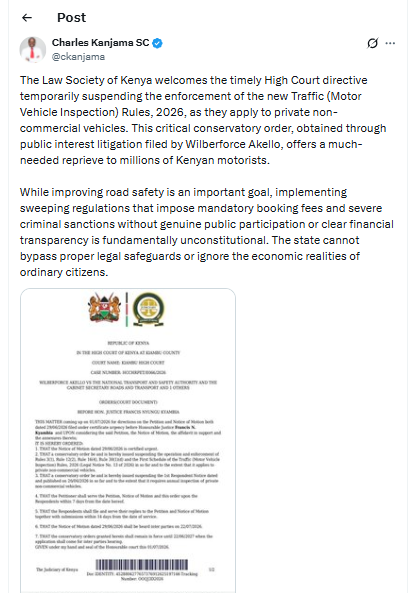
He said the orders, secured through public interest litigation filed by lawyer Wilberforce Akello, had offered much-needed relief to millions of motorists who were set to face mandatory annual inspections and additional compliance costs.
Court blocks new inspection rules
The remarks come a day after the Kiambu High Court halted the implementation of NTSA’s new private motor vehicle inspection rules following an urgent petition challenging the legality of the regulations.
In a ruling delivered on Wednesday, July 1, 2026, Justice Francis Nyungu Kyambia suspended enforcement of key provisions under the Traffic (Motor Vehicle Inspection) Rules, 2026, including annual mandatory inspections for private non-commercial vehicles.

The court also stopped enforcement of the gazette notice published on June 26, 2026, which had directed all privately owned and government vehicles older than four years to undergo annual inspection.
LSK raises constitutional concerns
Kanjama argued that although road safety remains a critical national priority, the government cannot impose sweeping regulations without public participation or financial accountability.
“While improving road safety is an important goal, implementing sweeping regulations that impose mandatory booking fees and severe criminal sanctions without genuine public participation or clear financial transparency is fundamentally unconstitutional,” he said.
He further faulted the state for allegedly bypassing legal safeguards while ignoring the economic burden such regulations would place on ordinary Kenyans.
Petitioners challenging the rules have argued that motorists risk facing unconstitutional fees, harsh criminal sanctions, imprisonment of up to six months and hefty fines if the regulations are allowed to proceed.
The matter is scheduled for hearing on July 22, 2026, when the court will determine the fate of the contested regulations.