Advertisement
Leonids meteor shower to light up Kenyan skies – Space Agency
Monday 17th November, 2025 12:50 PM|

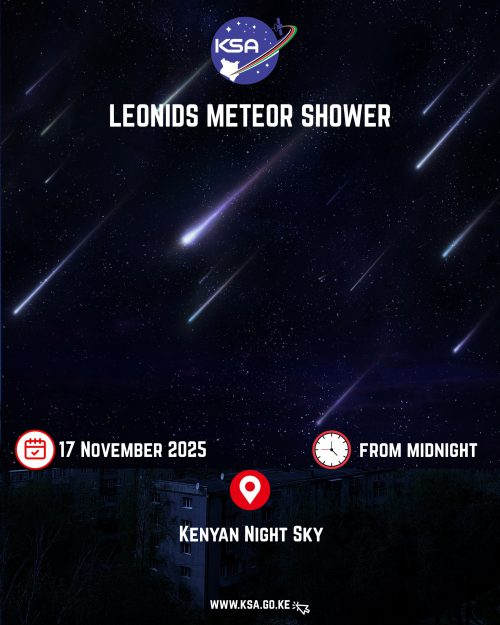
Kenya is set for a celestial spectacle tonight as the annual Leonids meteor shower reaches its peak, with the Kenya Space Agency confirming favourable viewing conditions across the country.
According to the agency, the event will be visible from midnight until dawn, offering an opportunity for both astronomy enthusiasts and the general public to witness one of the year’s most anticipated sky shows.
In an X post dated November 17, 2025, the agency noted, “The Leonids Meteor Shower reaches its peak tonight, offering an excellent opportunity for skywatchers and astronomy enthusiasts across Kenya.”
Origins of the Leonids
The Leonids meteor shower derives its name from the constellation Leo, where the meteors appear to originate. “Named Leonids because the meteors appear to radiate from the constellation Leo,” the agency explained in its statement.

The phenomenon occurs when Earth moves through debris trails left behind by Comet 55P/Tempel–Tuttle, which orbits the Sun every 33 years. “The shower is produced as Earth passes through debris trails shed by Comet 55P/Tempel–Tuttle. As these tiny particles enter our atmosphere at extremely high speeds, they heat up and create the bright, fast streaks of light visible across the night sky,” the Space Agency said.
Viewing conditions and tips
Although the Leonids are not expected to reach storm-level intensity this year, observers may catch 15–20 meteors per hour under clear, dark skies. Ideal viewing locations include rural parts of Kajiado, Laikipia, Samburu, and the Aberdare ranges, where light pollution is minimal.
- Observe from midnight until dawn for optimal visibility.
- Select a location with minimal light pollution to enhance your viewing experience.
- No special equipment is required; simply look up and enjoy the celestial display.
To enhance visibility, the Kenya Space Agency has issued simple guidelines: “Observe from midnight until dawn for optimal visibility. Select a location with minimal light pollution to enhance your viewing experience. No special equipment is required; simply look up and enjoy the celestial display.”
Members of the public have been encouraged to take advantage of the natural event. “The Kenya Space Agency encourages the public to take a moment tonight to connect with the wonders of our universe,” the agency added.
History of spectacular displays
The Leonids have been recorded since 902 AD and are known for producing meteor storms in some years.
Past outbursts include the 1833 storm, which produced an estimated 100,000 meteors per hour, as well as strong displays in 1966 and 2001–2002.
While tonight’s shower is expected to be moderate, stronger activity is forecast between 2031–2034 when Earth crosses denser debris streams.
The event comes amid a growing interest in astro-tourism in Kenya, following recent celestial occurrences such as the September 2025 blood moon and this month’s Beaver Supermoon.
Author
Latest News








Advertisement
More on News