Advertisement
Govt warns Central Rift flooding could worsen as El Niño looms
Thursday 23rd July, 2026 10:30 PM|

The government has warned that flooding in the Central Rift Valley could worsen later this year as forecasts point to a high probability of strong El Niño rains between October and December 2026.
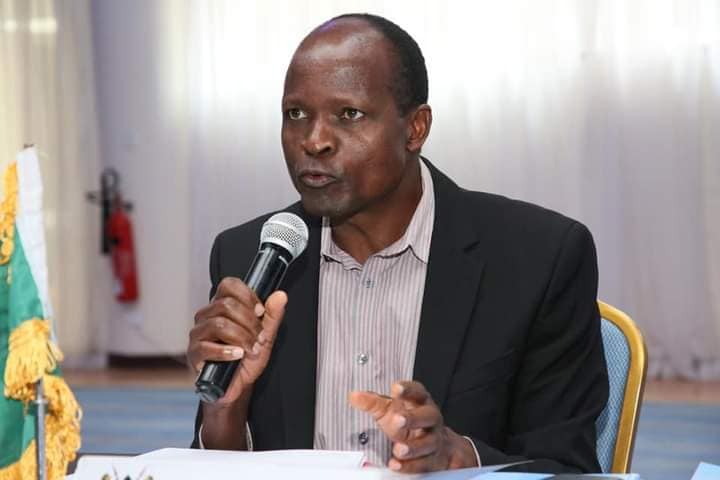
Chief of Staff and Head of the Public Service Felix Koskei said the Lake Baringo-Bogoria Basin continues to experience rising water levels driven by climate variability, prolonged above-average rainfall and catchment degradation.
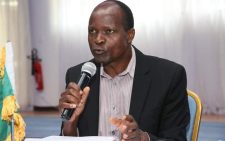
Speaking on July 23, 2026, during the First Consultative Meeting on the Status and Progress of the Lake Baringo-Bogoria Basin, Koskei described the situation as one of the country’s most significant environmental and humanitarian challenges.
According to the government, Lake Baringo has expanded by 119.08 square kilometres since 2010, while Lake Bogoria has grown by 10.90 square kilometres, permanently inundating about 130 square kilometres of land.
You Might Also Like
“The Lake Baringo-Bogoria Basin is experiencing a sustained hydrological shift driven by climate variability, prolonged above-average rainfall and catchment degradation.”
“The resulting rise in lake levels has become one of the most significant environmental and humanitarian challenges facing the Central Rift,” he noted in part.
Rising waters displace thousands
The expanding lakes have displaced thousands of households and damaged critical infrastructure across Baringo County.
Homes, schools and health facilities have been affected, while hotels, fishing grounds, farms and tourism facilities have been submerged by the rising waters.
Government assessments indicate that more than 40,000 people have been affected in Baringo North, Baringo South and Tiaty sub-counties.
Officials attributed the continued rise in lake levels to changing rainfall patterns that began around 2009.
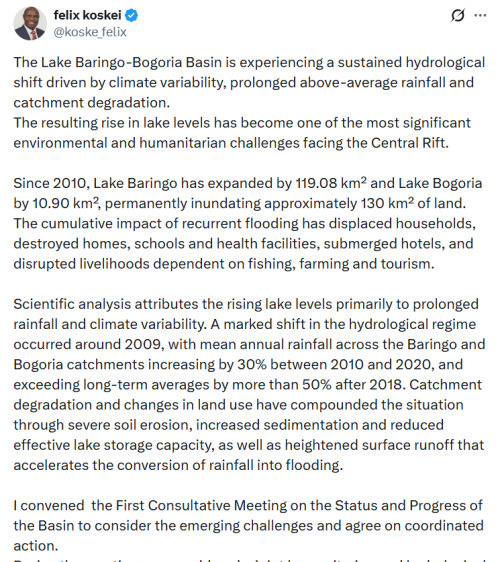
They noted that average annual rainfall across the basin increased by about 30 per cent between 2010 and 2020 and has remained more than 50 per cent above long-term averages since 2018.
The government also cited soil erosion, sedimentation and changes in land use as factors reducing the lakes’ storage capacity and increasing surface runoff into the basin.
Government outlines response
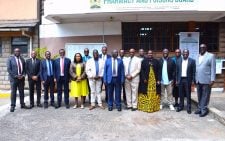
The consultative meeting brought together Principal Secretaries John Tanui (ICT and Digital Economy), Festus Ng’eno (Environment and Climate Change), Ephantus Kimotho (Irrigation), the Natural Resources Secretariat and officials from Baringo County.
The team reviewed a joint humanitarian and hydrological decision brief titled Rising Waters of the Central Rift.
Officials also considered forecasts showing an 81 per cent probability of a very strong El Niño event between October and December 2026, raising concerns over additional flooding if preparedness measures are not strengthened.
In response, the government said it will enhance early warning systems, evacuation planning, shoreline protection and drainage works in affected areas.
Plans also include resilient resettlement programmes, restoration of degraded catchments and protection of ecosystems, including the basin’s Ramsar sites.
Focus on long-term resilience
Beyond emergency interventions, the government is exploring ways of using excess water to support irrigation and strengthen food security.
Among the proposals under consideration are the construction of a gravity canal and a new dam to expand irrigated agriculture while helping regulate water levels in the basin.
“The Government’s focus is to protect lives and livelihoods, restore affected communities and ecosystems, strengthen climate resilience, and secure sustainable water management so that the basin remains safe, productive and resilient for present and future generations,” Koskei said.
The government said it will continue working with national and county agencies to coordinate interventions as the country prepares for the expected El Niño season later this year.
Author
Latest News





Advertisement
More on News