Kenyan parents fund public education despite govt’s promise of free schooling-report
By Aloys Michael, May 16, 2026Kenya’s promise of free primary education has long been celebrated as a cornerstone of social progress.
Yet beneath this policy commitment lies a parallel reality: families are quietly financing the survival of public schools.
The Usawa Agenda report 2026, the report exposes the financial strain placed on households, revealing that “free education” is far from free in practice.
One of the most alarming findings is dropout pressure driven by cost.
“4 in 10 children drop out due to lack of fees,” the report reads.
This statistic alone challenges the assumption that financial barriers were eliminated. Instead, they appear to have shifted form rather than disappeared.
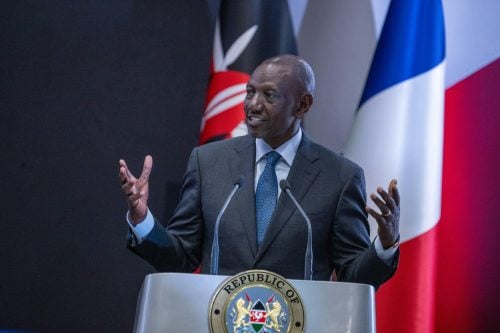
FLANA findings come even as President William Ruto continues to defend his administration’s education reforms amid growing criticism over funding shortfalls and operational challenges facing schools and universities across the country.
Speaking during the 120th anniversary celebrations of Maseno School on Saturday, May 9, 2026, Ruto dismissed claims that Kenya’s education sector is in crisis, instead pointing to what he described as significant progress made under his government.
“Don’t worry about the pessimists and the people who see nothing good,” the president said, urging Kenyans not to focus solely on negative narratives surrounding the sector.
“There was no crisis when we had a shortage of 100,000 teachers. Now that we have hired 100,000 teachers, there is a crisis,” he said.
However, despite reforms introduced by the government, concerns continue to grow over the sustainability of the sector as enrolment rises while funding remains constrained.
In secondary schools, enrolment has remained high during the transition from the 8:4:4 system, with about 3.34 million learners currently in Forms 2, 3, and 4 in 2025.
Education stakeholders have raised concerns that resources have not kept pace with the increasing student population.
Universities are also facing severe financial strain, with institutions projected to face a Ksh260 billion funding shortfall in the 2026/2027 financial year.
At least 23 public universities are reported to be at risk of insolvency due to pending bills amounting to Ksh85.28 billion as of January 2026, affecting their ability to meet operational costs, staff salaries, and statutory obligations.
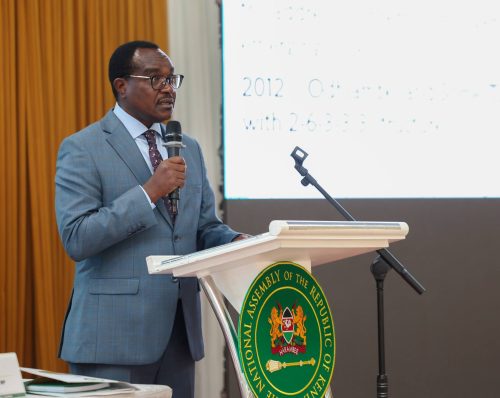
The introduction of the student-centred Variable Scholarship and Loan Funding (VSLF) model in 2023 was meant to improve equity and efficiency in university financing. However, the shift from block grants to individualised funding has sparked criticism.
Stakeholders argue that the Means Testing Instrument (MTI) used to assess students’ financial need is flawed, potentially locking out deserving but vulnerable learners.
Even for those who qualify, the support is often insufficient. Households continue to shoulder high costs, including accommodation, food, and transport, at a time when the cost of living remains high.
Funding gaps
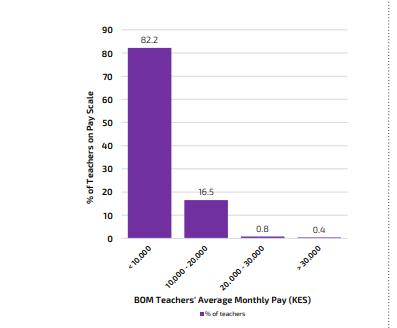
The funding structure within schools reveals how deeply parents are involved in sustaining basic operations. In many cases, they are effectively subsidising teacher salaries through Boards of Management (BOMs):
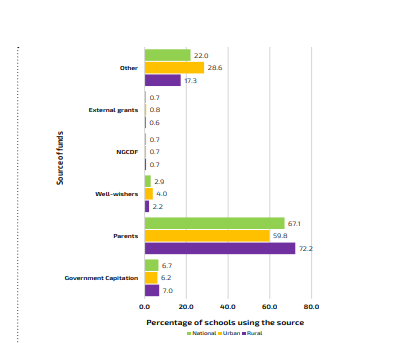
“67 in 100 shillings paid to BOM teachers come from parents.”
This means that the state does not cover the majority of certain teacher-related costs, but households already face economic pressure as the conditions in rural areas worsen.
“70 in 100 shillings paid to BOM teachers in rural areas come from parents,” the report observes.
At the same time, government capitation plays a surprisingly small role:
“6.7 in 100 shillings paid to BOM teachers come from government capitation,” the report notes.
This imbalance reveals a fragmented financing system where state funding is insufficient to sustain operational demands, forcing schools to rely on community contributions, levies, and informal payments.
For many families, these costs are unpredictable and difficult to sustain. They include contributions for teacher salaries, school maintenance, exams, and infrastructure needs. Over time, this creates financial fatigue, leading some parents to withdraw their children from school entirely.
The result is a quiet but persistent inequality. While policy promises universal access, the reality is conditional access, dependent on a household’s ability to absorb hidden costs.