Advertisement
Kenya, US Ksh207B health deal officially formalised despite backlash
Monday 08th June, 2026 04:26 PM|

Kenya and the United States have officially moved forward with the implementation of a long-disputed Ksh207 billion health cooperation agreement, ending months of uncertainty after court battles temporarily halted the programme.
Initially, the High Court halted implementation in December 2025, shortly after signing, citing constitutional questions raised by petitioners.
However, the U.S. later paused its own rollout in February 2026, saying it would respect the ongoing judicial process.
The Court of Appeal later ruled that maintaining the freeze risked undermining essential health services, allowing the government to proceed with implementation and effectively restoring the partnership’s rollout pathway.
You Might Also Like



In a statement on Monday, June 8, 2026, the Treasury Principal Secretary, Chris Kiptoo, confirmed that both governments had finalised arrangements to roll out the five-year partnership nationwide, describing it as a renewed phase in bilateral health collaboration.
“We have reached agreement on the implementation of the Kenya–U.S. Health Cooperation Partnership, a five-year programme valued at US$1.6 billion,” Kiptoo wrote on X.
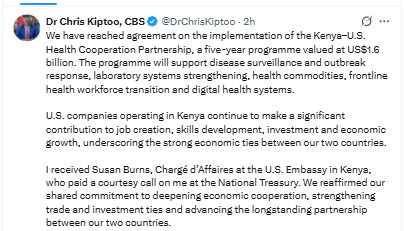
The programme is designed to strengthen multiple areas of Kenya’s health system, including disease surveillance, outbreak preparedness, laboratory infrastructure, medical supplies distribution, transition of frontline health workers, and expansion of digital health systems.
The announcement followed a courtesy meeting between Kiptoo and U.S. Chargé d’Affaires Susan Burns at the National Treasury, where both sides reaffirmed their commitment to deepening economic and development cooperation.
Moreover, Kiptoo also emphasised the broader economic relationship between the two countries, pointing to the role of American firms in Kenya’s labour market and investment landscape.
“U.S. companies operating in Kenya continue to make a significant contribution to job creation, skills development, investment and economic growth, underscoring the strong economic ties between our two countries,” the statement read.
The deal had previously been stalled after the Court of Appeal temporarily lifted a High Court order that had frozen its implementation.

The legal pause had delayed rollout for several months amid ongoing litigation.
Opposition to the agreement has been persistent, with civil society groups, legal experts, and some lawmakers arguing that the process lacked sufficient public participation and parliamentary scrutiny.
The deal’s pushbacks
Among the most vocal critics was Busia Senator Okiya Omtatah, who maintained that the executive had pushed through a significant international agreement without adequate transparency or legislative approval.
Concerns were also raised by the Consumers Federation of Kenya (COFEK) and the Katiba Institute, which warned that the arrangement could risk exposing sensitive patient information, including HIV and TB data, potentially conflicting with Kenya’s Data Protection Act.
Responding to those concerns earlier in the process, Susan Burns assured stakeholders that data protection safeguards were in place and would be respected under the partnership framework.

“The government of Kenya will continue to abide by [its] privacy laws. We are just putting on paper the similar policies that we’ve followed for many years, and any data-sharing going forward will be aggregated”, Burns said.
Further criticism came from the Kenya Legal & Ethical Issues Network on HIV and AIDS (KELIN), which argued that clauses granting immunity to U.S. personnel and contractors could limit accountability within Kenyan courts in cases involving data misuse or disputes.
The agreement also faced scrutiny over its financial structure, with critics pointing to an additional Ksh110 billion obligation expected from Kenya to support priority health programmes aligned with the deal.
Author
Latest News





Advertisement
More on News