Kenya, US deepen defence partnership to tackle East Africa security threats
By Aloys Michael, March 26, 2026Kenya and the United States have strengthened their defence partnership in a move aimed at tackling escalating security threats in East Africa.
During the meeting, the two military leaders discussed regional security challenges, counterterrorism strategies, and the increasing role of emerging technologies in modern defence operations. The discussions also focused on enhancing bilateral defence cooperation, particularly in maritime security and joint training initiatives.
“Continued collaboration between Kenya and the United States is essential for addressing evolving security challenges and improving regional operational readiness,” General Kahariri said in a statement following the meeting.
Admiral Wikoff praised the professionalism of the Kenya Defence Forces (KDF), emphasising their role in promoting regional peace and stability.
“Our partnership with the Kenya Defence Forces is vital in advancing shared security interests,” he said, highlighting the importance of ongoing joint exercises and capacity-building programs.
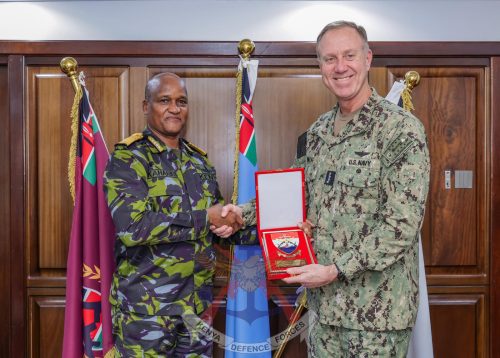
The visit cements the longstanding military relationship between Kenya and the United States, which has historically focused on capacity development, maritime domain awareness, and coordinated operations.
The efforts are particularly critical in regions bordering Somalia, where security threats remain high.
The border insecurity
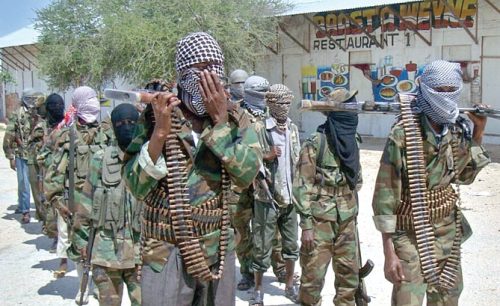
The Kenya-Somalia frontier, stretching over 680 kilometres across Mandera, Wajir, and Garissa counties, has become a focal point in the fight against the Somalia-based extremist group Al-Shabaab.
In these remote areas, state authority is limited, and militants exploit gaps to carry out cross-border attacks before retreating into Somalia.
According to the 2026 Global Terrorism Index by the Institute for Economics & Peace, nearly 41 per cent of terrorist attacks globally occur within 50 kilometres of an international border, while 64 per cent happen within 100 kilometres.
“Border proximity is a defining feature of modern terrorism,” the report states, highlighting how weakly governed frontier zones facilitate extremist operations.
The Kenya-Somalia border is marked by harsh terrain, including dry riverbeds, scrubland, and minimal infrastructure.
While formal crossing points are scarce, hundreds of informal routes used by pastoralist communities allow for rapid, undetected movement. Fighters often blend into local populations with shared languages, clan ties, and livelihoods, complicating surveillance and enforcement.
“Borderlands often represent authority gaps: remote areas where state control is weakest,” the report notes.
Expanding bilateral cooperation
The recent discussions between Kenya and US military leaders included plans to expand cooperation in intelligence sharing, counterterrorism training, and technology-driven operations.
Maritime security, in particular, is a priority, given the strategic importance of the Indian Ocean for regional trade and security.
General Kahariri said that enhanced coordination would not only deter cross-border incursions but also strengthen Kenya’s broader capacity to respond to evolving threats.
“Our commitment is to ensure a safer region through professional and coordinated defence strategies,” he said.
Admiral Wikoff echoed this sentiment, noting that joint exercises and knowledge exchange remain critical tools in building resilient security forces.
“The professionalism and dedication of the Kenya Defence Forces set a strong example for regional cooperation,” he said.