Advertisement
Kenya scores 30 in 2025 corruption index, among region’s worst performers
Tuesday 10th February, 2026 12:26 PM|

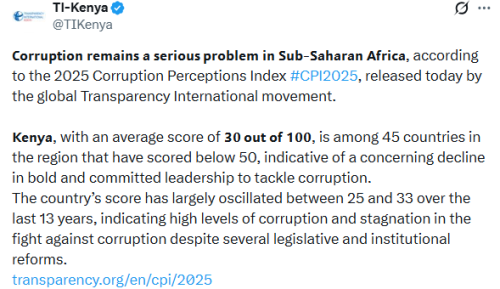
Kenya remains among the worst-performing countries on corruption in Sub-Saharan Africa after scoring 30 in the 2025 Corruption Perceptions Index (CPI), according to Transparency International (TI).
The index, released on February 10, 2026, shows that corruption continues to undermine governance and public trust in Kenya despite years of reforms. Transparency International’s official country data lists Kenya’s 2025 score at 30 out of 100, a two-point decrease from the previous year, placing the country at position 130 out of 180 globally.
TI-Kenya, the local chapter of the global watchdog, reports an average score of 30, noting that Kenya’s performance has fluctuated between 25 and 33 over the past 13 years. The organisation says the small improvement does not change the overall picture of stagnation.
Kenya remains below the global average score of 42. Out of 49 countries in the region, only four score above 50, a threshold that signals stronger control of corruption.
You Might Also Like



The best-performing countries in Sub-Saharan Africa are Seychelles with 68, Cape Verde with 62, Botswana with 58, and Rwanda with 58. At the bottom of the table sit South Sudan and Somalia, both with a score of 9, followed by Eritrea at 13 and Sudan at 14.
Kenya falls among 45 African countries that score below 50, a group that Transparency International says shows limited or no progress despite constitutional, legal, and institutional reforms.
Global corruption deepens
Globally, the situation is also worsening. The average CPI score has dropped to 42, the lowest level in more than ten years. More than two-thirds of countries worldwide, 122 out of 180, score below 50.
Even long-established democracies record declines. The United States scores 64, the United Kingdom 70, and France 66, reflecting growing concerns about accountability and public sector integrity.
François Valérian, Chair of Transparency International, warned that corruption continues to block development and democratic progress.
“Corruption is not inevitable,” Valérian said. “Our research and experience as a global movement show there is a clear blueprint for how to hold power to account for the common good, from democratic processes and independent oversight to a free and open civil society.”
The report links rising corruption to shrinking civic space. Since 2012, 36 of the 50 countries with the largest score drops have also restricted freedoms of expression, association, and assembly. Transparency International reports that at least 150 journalists have been murdered in non-conflict settings since 2012 for exposing corruption.
TI-Kenya echoed these concerns and warned that pressure on media, civil society organisations, and whistleblowers weakens accountability.
In response to the findings, TI-Kenya called for urgent action. The organisation urged the government to protect civic space and media freedom, pass a comprehensive whistleblower protection law, and strengthen transparency in public procurement through open digital systems.
It also called for proper funding of anti-corruption agencies, tighter regulation of campaign financing ahead of the 2027 general election, and full enforcement of Chapter Six of the Constitution on leadership and integrity.
Author
Kenneth Mwenda
Kenneth Mwenda is a business, sports, and politics digital writer with over seven years of experience in journalism, covering breaking news, feature stories, and in-depth analysis across a range of beats.
For inquiries, he can be reached at [email protected]
View all posts by Kenneth MwendaLatest News







Advertisement
More on News