Kenya joins Pan-African push for women leadership and equality
By Faith Lagat, May 8, 2026Kenya has sent a high-level delegation to the Pan-African Women’s Organization (PAWO) Council Meeting in Luanda, as African women leaders convene to discuss gender equality, leadership and socio-economic empowerment across the continent.
Among the Kenyan leaders attending the meeting is Esther Passaris, who described the gathering as a historic platform bringing together women leaders from across Africa.
In a statement shared on X, Passaris said: “Honoured to join fellow women leaders from across Africa here in Luanda, Angola, for the Pan-African Women’s Organization (PAWO) Council Meeting.”
PAWO’s role in Africa
Pan-African Women’s Organisation was founded in 1962 before the formation of the Organisation of African Unity, now the African Union. For decades, the organisation has championed women’s rights, liberation movements, peace-building, political participation and socio-economic empowerment across Africa.
Kenya continues to play a role within the organisation through Mary M. Khimulu, who serves as Vice President for the East Africa Region.
The Kenyan delegation is led by Anne Wang’ombe on behalf of Gender Cabinet Secretary Hanna Wendot Cheptumo. Other members of the delegation include Rehema Jaldesa, Margaret Kamar, Zipporah Kittony and Rahab Mwikali Muiu.
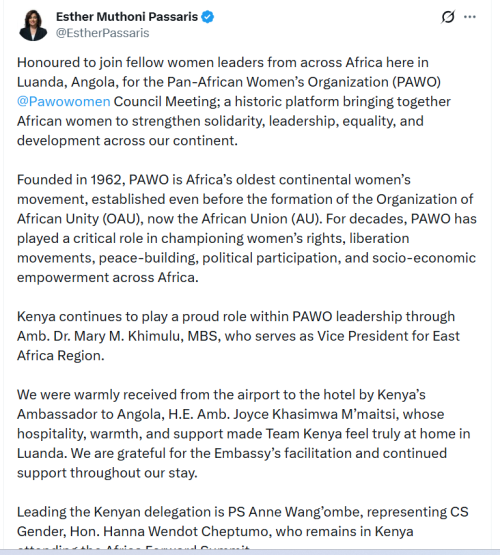
The delegation was received by Joyce Khasimwa M’maitsi, who welcomed the Kenyan team to Angola and facilitated their participation during the meeting.
Passaris noted that the gathering reflects Kenya’s commitment to advancing women’s leadership and inclusivity across Africa.
Gender representation debate
Kenya’s participation in the forum comes amid continued debate over the implementation of the two-thirds gender rule in the country.
Despite constitutional provisions aimed at ensuring gender balance in elective and appointive positions, women remain underrepresented in several leadership positions.
Martha Karua recently criticised political parties over the nomination of female candidates, arguing that women are often sidelined during party nominations.
Karua also called for reforms to improve women representation, including consideration of proportional representation systems used in countries such as South Africa.