Kenya imports 70% of its medicines worth Ksh76B as local production lags
By Kenneth Mwenda, January 12, 2026Kenya continues to rely heavily on imported medicines, with about 70 per cent of drugs used in the country coming from abroad.
The pharmaceutical market is valued at roughly Ksh76 billion, leaving local manufacturers supplying only about 30 per cent of demand.
This challenge took centre stage on Monday when the Kenya Investment Authority (InvestKenya) hosted a Pharmaceutical Sector Roundtable in Nairobi.
The meeting brought together stakeholders from the Ministry of Health, the International Finance Corporation (IFC), Manufacturing Africa, the Vision 2030 Delivery Secretariat, the Kenya Development Corporation (KDC), and the Kenya Association of Manufacturers (KAM).
Participants highlighted a wide gap between demand and local supply. More than 85 per cent of essential medicines are not produced in Kenya at all. As a result, the country imports most of its drugs. This dependence exposes Kenya to supply disruptions, currency volatility, and pressure on foreign exchange reserves.
“Discussions highlighted a major demand–supply gap, with over 85% of essential medicines not manufactured locally and imports accounting for about 70% of the pharmaceutical market, valued at approximately KES 76 billion,” InvestKenya said in its update.
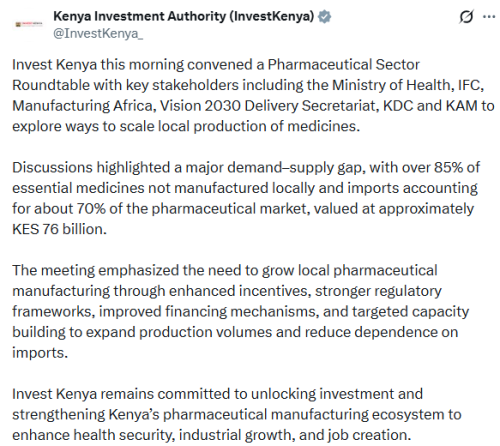
Stakeholders agreed that expanding local manufacturing is urgent. They called for better investment incentives, stronger regulatory support, improved access to finance, and skills development to raise production capacity. These measures would help reduce imports, create jobs, and strengthen health security.
Push for local manufacturing
The government has already set targets to address the imbalance. A presidential directive issued in 2023 aims to ensure that at least 50 per cent of medicines on the Kenya Essential Medicines List are produced locally by the end of 2026. However, progress remains slow, with local production still at about 30 per cent.
Kenya’s pharmaceutical sector is the largest in East Africa, but it mainly focuses on formulation rather than the manufacture of active pharmaceutical ingredients. This limits the country’s ability to fully control supply chains and costs.
Alongside efforts to boost medicine manufacturing, the government is also advancing local vaccine production. Health Cabinet Secretary Aden Duale recently confirmed that Kenya has begun the second phase of local vaccine manufacturing at the Kenya BioVax Institute.
During his first visit to the institute, Duale said local vaccine production is central to Kenya’s Universal Health Coverage strategy. He noted that the first phase of the project, fully funded by the government, has been completed. The second phase focuses on systems integration and the installation of key equipment, including fill-and-finish technology.
Duale said the institute is working towards producing Kenya’s first trial batch of locally manufactured vaccines by the end of 2027. The facility will also support the production of other essential health products, such as insulin, snake anti-venoms, biosimilar anti-cancer drugs, and medical infusions.