Kenya Freedom Index: Protest deaths soared under Ruto’s govt as youth faced state crackdown
By Aloys Michael, May 22, 2026A new report by Amnesty International Kenya and Odipo Dev paints a grim picture of civic freedoms in Kenya, revealing how protest-related deaths escalated sharply between 2023 and 2025 as anti-government demonstrations intensified under President William Ruto.
The Kenya Freedom Index, released on Friday, May 22, 2026, traces a deadly pattern in the country’s recent political history: protest-related killings did not rise steadily, but instead surged alongside moments of heightened political tension, economic hardship, and state repression.
“Protest-related deaths in Kenya did not rise in a straight line,” the report states. “They rose and fell with the political calendar and with the intensity of repression.”
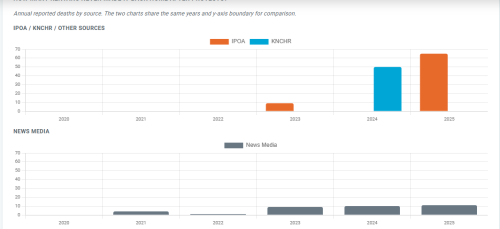
According to the findings, deaths linked to demonstrations remained relatively low between 2020 and 2022. However, 2023 marked the first major spike after Ruto’s ascension to power following the fiercely contested 2022 General Election. Around nine deaths were recorded as opposition-led anti-government protests erupted across the country over the rising cost of living and claims of electoral injustice.
But it was 2024 that fundamentally altered Kenya’s protest landscape.
The report documents 54 protest-related deaths in June and July 2024 alone, during the Gen Z-led demonstrations against the controversial Finance Bill. The protests, largely mobilised online and driven by young Kenyans demanding economic accountability, culminated in the government withdrawing the proposed tax measures after weeks of sustained public pressure.
Despite the Finance Bill 2024 being shelved, the report says the human cost of the demonstrations remains unresolved.
“A generation that organised online, marched peacefully, and forced the withdrawal of a major fiscal policy was met with live ammunition,” the report notes. “The Finance Bill was withdrawn. The dead were not brought back. No one was held accountable.”
The index further reveals that 2025 became the deadliest year in the six-year dataset, with 70 protest-related deaths recorded nationwide.
Particularly shocking were the events surrounding the first anniversary of the Finance Bill protests. On June 25, 2025, the Independent Policing Oversight Authority (IPOA) recorded 23 deaths in a single day during commemorative demonstrations. Less than two weeks later, on July 7, during the Saba Saba protests, another 41 people were killed.
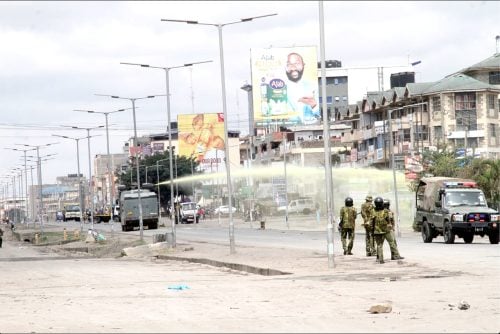
In total, 64 people died within two months.
Fatalities category
“What changed between 2024 and 2025?” the report asks. “The answer is in the 15-person difference that nothing changed, and when nothing changes after 54 people die, 70 more follow.”
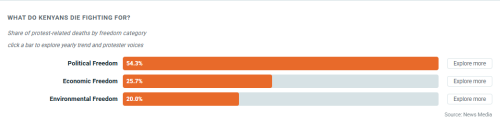
The report categorises the fatalities according to the motivations behind the demonstrations. Protests linked to political freedoms accounted for 19 deaths, while demonstrations over economic grievances such as taxation, unemployment, inflation, and the soaring cost of living accounted for another nine.
Environmental justice protests also emerged as a deadly flashpoint, with seven people killed during demonstrations against land evictions, environmental degradation, and forced displacement.
“These are often the most marginalised protesters,” the report explains, pointing to rural communities and indigenous groups with limited access to platforms capable of amplifying their demands for justice.
A significant focus of the Kenya Freedom Index is the disproportionate impact on young people.
From 2023 onwards, Kenya’s youth became the face of anti-government mobilisation, demanding accountability from a political establishment many felt had failed them economically and politically. According to the report, young people accounted for 40 per cent of all recorded protest-related fatalities.
“The data suggests that young Kenyans who tried to exercise that sovereignty paid for it with their lives at a rate no other group came close to,” the report says. “Youth are not just the most active protesters in Kenya. They are the most targeted.”
The findings also highlight another disturbing trend: many victims were not protesters at all.

Among the cases cited is that of 22-year-old Boniface Mwangi Kariuki, a mask vendor shot in the head at close range by a police officer in Nairobi’s central business district on June 17, 2025. Kariuki was later declared brain-dead at Kenyatta National Hospital before dying on June 30.
The report also references 12-year-old Bridgit Njoki, who was killed inside her home during the July 7, 2025 Saba Saba protests after a bullet pierced the roof and struck her in the head while she watched television.
Another victim, security guard Fred Wamale Wanyonyi, died while on duty at a Nairobi mall during the June 25 protests.
“These deaths deserve their own count and their own reckoning,” the report states. “They show that the cost of how Kenya polices protests is borne not only by those who protest, but by the communities in which protests occur.”
The release of the report comes amid mounting controversy over the government’s proposed compensation framework for victims of the 2024 and 2025 demonstrations.
Protest victims compensation
The government, through the Kenya National Commission on Human Rights (KNCHR), has proposed compensation of Ksh3 million for families of those killed and Ksh2 million for victims of enforced disappearances.
However, victims’ families and activists have rejected the proposal as inadequate.
“We demand the establishment of a clear, minimum tax-exempt compensation of five million shillings for loss of life and disappearance,” said George Obienge, who lost his child during the protests.
Families are also demanding broader reforms, including public acknowledgement from President Ruto over alleged human rights violations committed during the demonstrations.
“The president must publicly acknowledge what happened in 2024 and 2025,” Obienge added.
Activists have further accused the government of rushing the reparations process for political expediency.
“We are deeply concerned that this process is being rushed for political reasons,” activist Shakira Wafula said, as victims called for a 90-day extension to the KNCHR submission deadline.
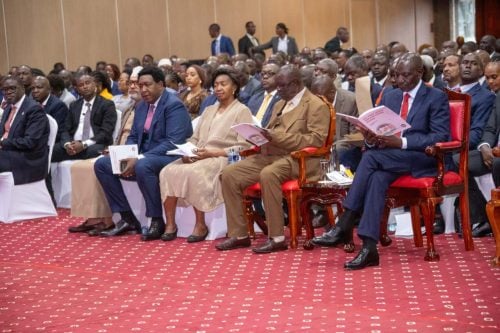
Speaking during a joint parliamentary session at the Kenyatta International Convention Centre (KICC) in March, President Ruto defended the government’s compensation plan and announced a Ksh2 billion allocation toward reparations.
“Although we are being told, and it is correct, that you can never compensate for life, we can do something about it,” Ruto said.
Still, as pressure mounts from victims, activists, and rights groups, the Kenya Freedom Index has intensified scrutiny on the government’s handling of dissent and the deadly consequences of protest policing in the country.
For many families, compensation alone is no longer enough. Accountability, justice, and institutional reform remain at the centre of Kenya’s growing human rights debate.