Advertisement
Kenya-Egypt ties take strategic turn amid regional shifts
Thursday 24th July, 2025 11:03 AM|

As geopolitical dynamics shift across Africa and the Middle East, Kenya is signalling a renewed commitment to its relationship with Egypt, one of the continent’s key political and economic players.
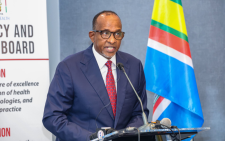
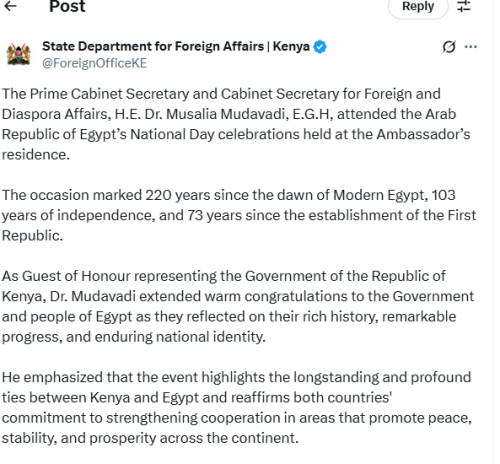
This was underscored by Prime Cabinet Secretary and Cabinet Secretary for Foreign and Diaspora Affairs, Musalia Mudavadi, who represented Kenya at Egypt’s National Day celebrations in Nairobi on Wednesday, July 24, 2025.
The ambassador’s departure comes at a time when both countries are recalibrating their foreign policies. Egypt is increasingly engaging sub-Saharan Africa, while Kenya is positioning itself as a diplomatic hub in a post-pandemic world order.
Hosted at the Egyptian Ambassador’s residence, the event marked 220 years since the dawn of Modern Egypt, 103 years of independence, and 73 years since the formation of the First Republic.
You Might Also Like



In a region grappling with growing insecurity in Sudan, political transition in Ethiopia, and trade realignments in the Horn of Africa, the timing and tone of Mudavadi’s message carried significant weight.
“Today’s occasion is more than a ceremonial observance. It is a reaffirmation of the deep-rooted and strategic partnership between Kenya and the Arab Republic of Egypt. This partnership is built on mutual respect, historical solidarity, and a shared vision for a stable and prosperous Africa,” Mudavadi said in a keynote address.
While Egypt has long been a major political actor in North Africa, its outreach to East Africa, particularly Kenya, has gained traction in recent years.
Mudavadi attribute this to a mix of economic ambitions and water diplomacy surrounding the Nile Basin. Kenya, for its part, is seeking stronger regional alliances to counterbalance a volatile neighbourhood and expand its economic footprint beyond the East African Community.
“Egypt-Kenya relationship has moved beyond ties to tangible cooperation,” he noted, citing the signing of the Kenya-Egypt Joint Declaration for a Strategic and Comprehensive Partnership earlier 2024 as a turning point.
“This declaration, signed by President William Ruto and President Abdel Fattah El-Sisi, is not just diplomatic ink on paper. It sets the foundation for practical collaboration in trade, investment, education, research, and technology.”
The growing economic dimension of the partnership is particularly notable. Egypt, a manufacturing hub with advanced infrastructure, sees Kenya as a gateway to East and Central Africa.

The Kenya-Egypt deal
Meanwhile, Kenya is eyeing Egyptian expertise in renewable energy and agricultural technology as it works to achieve food and energy security.
But the relationship is not without its complexities. Egypt’s assertive stance on the Grand Ethiopian Renaissance Dam (GERD) continues to be a point of contention in the region, especially with Ethiopia, another of Kenya’s key allies. Observers say Kenya’s strengthened ties with Egypt may require careful diplomatic balancing.
Even so, Kenya’s top diplomat used the occasion to highlight the potential for Egypt and Kenya to act as stabilising anchors in a continent increasingly shaped by internal conflict and global competition for resources.
“As we look ahead, Egypt and Kenya must leverage their historical positions as regional leaders to champion peace, counter extremism, and promote intra-African trade through frameworks like the African Continental Free Trade Area (AfCFTA),” Mudavadi noted.
The event also served as a farewell for outgoing Egyptian Ambassador to Kenya, H.E. Wael Nasreldin Attiya. Praising his tenure, Mudavadi noted that Ambassador Attiya’s efforts helped “unlock significant milestones” in bilateral ties.
As Kenya prepares to host several regional and international forums later in 2024, Mudavadi said the message to partners like Egypt is clear: it seeks not just friendship, but functional alliances built on shared interests and mutual benefit.
“The road ahead is one of opportunity. Together, Kenya and Egypt can chart a course of transformative cooperation that resonates far beyond our borders,” he asserted.
Author
Latest News








Advertisement
More on News