Kenya among top 10 African nations hit by severe drought in 2025
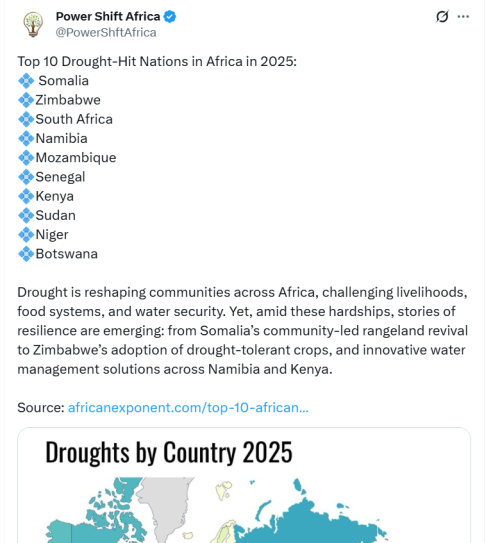
By Faith Lagat, August 31, 2025Kenya has been ranked among the top 10 African nations most affected by severe drought this year, a new report by Power Shift Africa has revealed.
The study, shared on August 31, 2025, shows that Kenya sits alongside Somalia, Zimbabwe, and South Africa in grappling with some of the harshest dry conditions on the continent.
According to the Power Shift Africa report, Kenya scored between 4 and 4.5 on the Drought Risk Index, reflecting the intensity and frequency of extreme weather events.
“Kenya faces low rainfall across its arid and semi-arid counties, including Turkana, Marsabit, and Garissa. These areas rely heavily on seasonal rains for both farming and pastoralism, making them highly sensitive to dry conditions. Crop production of maize and beans has fallen below average, and livestock losses have increased as grazing lands deteriorate,” read the Power Shift Africa report.
The World Bank notes that extreme drought conditions across Africa have surged by 233 per cent over the past five decades, leaving millions of households exposed to water shortages, crop failures, and livestock losses.
Hardship in arid counties
The crisis has been most pronounced in Kenya’s arid and semi-arid regions, including Turkana, Marsabit, and Garissa, where rainfall has been well below average. Farmers have reported reduced harvests of maize and beans, while pastoralist communities continue to lose livestock as grazing lands dry up.
The National Drought Management Authority (NDMA) says these conditions represent the most damaging drought episodes since 2020.
International observers have described the drought as one of the worst in the Horn of Africa. UNCCD drought specialist Daniel Tsegai warned that Kenya and Somalia face widespread hunger, with an estimated 1.7 million children in Kenya at risk of malnutrition.
A report launched this week by the Global Drought Hotspots initiative linked the crisis to global warming driven by fossil fuel emissions.
The prolonged dry spells are also taking a psychological toll. Research by Cyprian Mostert of Aga Khan University shows a 28.7 percent increase in suicidal ideation among rural women during extended droughts, rising to nearly 50 percent when food prices spike. Mostert called for urgent integration of mental health support into climate response strategies.
Resilience and adaptation
Despite these grim statistics, Kenya has been commended for resilience and innovation in mitigating the impacts of drought. The NDMA has expanded early warning systems to help communities act before crises escalate. Irrigation schemes such as Galana-Kulalu are sustaining food production beyond rainy seasons, while water trucking, borehole rehabilitation, and solar-powered supply systems are keeping remote settlements functional.
The push for climate-smart agriculture has also taken root, with farmers encouraged to diversify crops and adopt soil moisture conservation techniques. Renewable energy investments in solar, wind, and geothermal sources have reduced pressure on vulnerable water systems, though experts caution that high initial costs of solar equipment remain a challenge.
Continental challenge
Across the continent, countries are also shifting from short-term relief to long-term resilience. Botswana is expanding solar-powered boreholes, and Niger is restoring drylands through the Great Green Wall project, while South Africa has scaled up desalination and water recycling initiatives.
Power Shift Africa noted that while drought is reshaping communities across Africa, Kenya’s proactive measures stand out as a model for adaptation. However, the OECD warns that without urgent global cooperation, the economic costs of drought in Africa could rise by between 35 and 110 percent by 2035.