Advertisement
Kenya among countries in Israel’s Ebola travel restrictions list amid concerns
Saturday 13th June, 2026 03:52 PM|

The Israeli Ministry of Health has expanded its Ebola preparedness plan as cases continue to be reported in parts of the Democratic Republic of the Congo and Uganda.
Kenya has been included in the list of countries under consideration for temporary travel restrictions linked to the outbreak response.
The Epidemiology Division said in a statement dated June 10, 2026, it is actively monitoring the situation and holding “regular professional situation assessments” led by senior health officials. The ministry said it is working to reduce the risk of Ebola entering Israel while ensuring hospitals are ready to respond.
At present, no Ebola cases have been reported in Israel. Officials said the public risk remains low, but they warned that the disease’s high fatality rate and complex treatment needs require continuous readiness.
You Might Also Like


“The Ministry of Health is working to reduce the risk of the virus reaching Israel and to ensure optimal preparedness of the health system for any possible scenario,” the statement said.
Health system preparedness and hospital readiness
As part of its preparedness plan, the ministry is issuing updated clinical guidance to hospitals and medical teams. It has also begun procuring additional protective equipment and essential medical supplies.
Health officials are strengthening early detection systems for travellers arriving from affected regions. They are also reviewing screening procedures at entry points to identify possible cases earlier.
The ministry said these steps aim to improve response capacity and reduce the likelihood of delayed diagnosis if a suspected case appears.
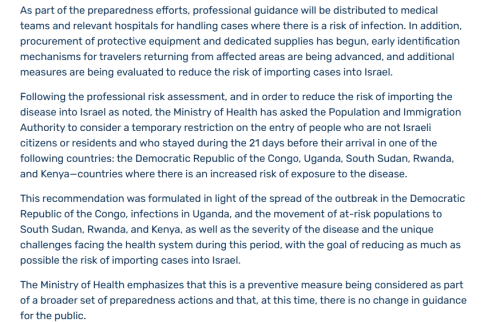
The Ministry of Health has asked the Population and Immigration Authority to consider a temporary restriction on entry for non-citizens and non-residents who have recently stayed in countries affected by Ebola.
The proposed list includes the Democratic Republic of the Congo, Uganda, South Sudan, Rwanda and Kenya.
Officials said the recommendation follows the spread of the outbreak in the Democratic Republic of the Congo, infections in Uganda, and movement of at-risk populations across the region.
They added that the aim is to reduce the risk of importing Ebola cases while balancing essential travel needs.
Travel advice and public guidance
The ministry has reiterated advice against non-essential travel to areas with active Ebola transmission, especially the Democratic Republic of the Congo and Uganda.
“If travel is necessary, individuals should seek personalised advice from a travel health clinic,” the ministry said.
Travellers returning from affected countries are being urged to monitor their health for 21 days. Those who develop fever or unusual symptoms must isolate immediately and contact the national hotline at *5400.
Officials said travellers should clearly report recent travel history when seeking medical attention to speed up response and reduce exposure risks.
The Ministry of Health said it will continue tracking global developments and update both medical teams and the public as needed. It stressed that preparedness measures remain preventive and are being adjusted based on ongoing risk assessments.
The statement reflects wider global efforts to tighten surveillance and improve readiness as Ebola outbreaks continue to affect parts of Central and East Africa.
The United Arab Emirates has also tightened its own travel advisory in response to the Ebola outbreak, raising fresh concern among Kenyan travellers who rely heavily on Gulf routes.
In a notice issued by the UAE National Emergency Crisis and Disasters Management Authority (NCEMA) and the Federal Authority for Identity, Citizenship, Customs and Port Security, authorities introduced stricter screening and entry controls for passengers linked to Uganda, the Democratic Republic of the Congo, and South Sudan.
The UAE said the measures are aimed at “strengthening preparedness to deal with the Ebola virus” and reducing the risk of cross-border transmission. While Kenya is not directly targeted, the advisory has triggered indirect concerns for Kenyan passengers, especially those who have recently travelled through affected countries or use regional transit hubs linked to East Africa.
Author
Kenneth Mwenda
Kenneth Mwenda is a business, sports, and politics digital writer with over seven years of experience in journalism, covering breaking news, feature stories, and in-depth analysis across a range of beats.
For inquiries, he can be reached at [email protected]
View all posts by Kenneth MwendaLatest News








Advertisement
More on News