Advertisement
UAE travel advisory raises questions for Kenyan travellers amid Ebola concerns
Saturday 06th June, 2026 04:29 PM|
The United Arab Emirates (UAE) has tightened its travel advisory measures as concern grows over the Ebola outbreak in parts of Central and East Africa. The move has triggered questions among Kenyan travellers, airlines, and tourism operators who rely on Dubai and Abu Dhabi as major transit hubs.
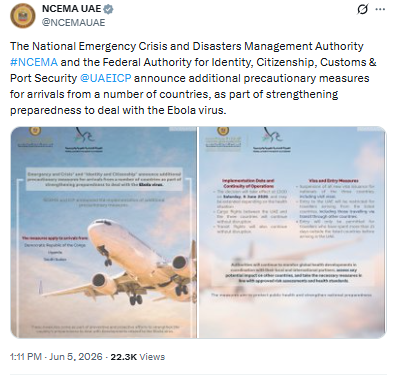
The UAE National Emergency Crisis and Disasters Management Authority (NCEMA), together with the Federal Authority for Identity, Citizenship, Customs and Port Security, announced new precautionary measures on June 2, 2026. The measures target travellers linked to Uganda, the Democratic Republic of Congo (DRC), and South Sudan.
The authorities said they acted to reduce the risk of Ebola entering the country through international travel routes. The directive includes entry restrictions and tighter screening rules for passengers who have recently been in the affected countries.
“The precautionary measures come as part of strengthening preparedness to deal with the Ebola virus,” NCEMA said in its official statement.
You Might Also Like



The decision takes effect on Saturday, June 6, 2026, as authorities begin enforcing the new travel advisory rules at UAE entry points.
What the UAE travel advisory says
Under the new rules, the UAE has suspended entry for travellers arriving directly or indirectly from Uganda, DRC, and South Sudan. This includes passengers transiting through other countries if their travel history links them to the affected states.
However, the UAE clarified that the restrictions do not affect all African countries. Travellers from unaffected countries, including Kenya, can still enter under normal visa and immigration rules.
The UAE also introduced a 21-day clearance rule. Travellers who have visited the affected countries must stay outside those regions for at least 21 consecutive days before being allowed entry into the UAE. The rule aligns with the Ebola incubation period used by global health agencies.
Authorities also confirmed that cargo and transit operations through UAE airports remain open. This means goods, connecting passengers, and logistics services will continue with limited disruption.
How this could affect Kenyans
For Kenya, the advisory does not impose a direct ban. Kenyan passport holders can still travel to the UAE. However, the impact could be indirect through travel history checks, regional movement, and transit complications.
Kenyans who have recently travelled through Uganda, South Sudan, or the DRC may face delays or extra screening before boarding flights to Dubai or Abu Dhabi. Airlines are expected to tighten verification of travel records.
Kenya also plays a central role in East African aviation. Many passengers from Uganda and South Sudan connect through Nairobi before flying to the UAE. This creates a risk of stricter airline checks across the region, even for travellers who start their journey in Kenya.
Laikipia Ebola facility and international concern
The advisory also comes at a time when global attention is on Kenya due to the proposed Ebola quarantine and treatment facility at Laikipia airbase. The United States has reportedly been preparing a controlled medical unit in Kenya to handle American health workers exposed to Ebola in the region.
Reports indicate that the facility will host a limited number of beds for observation and treatment, with advanced medical evacuation plans for critical cases.
Former US health officials have raised concerns about the arrangement, arguing that Ebola response systems should remain centralised in established biocontainment units.
“This policy raises profound clinical, ethical, operational and legal concerns,” former CDC officials said in a joint letter to US lawmakers.
The Laikipia facility has placed Kenya in a sensitive position. Health experts warn that any breach or “leakage” from such a facility could increase international travel restrictions on countries linked to the outbreak response.
If there is any exposure incident linked to a regional facility, countries may respond with blanket travel advisories, even for nations that are not directly affected.
This concern links directly to how the UAE and other countries design travel rules. Most Gulf states rely on risk-based classification. If Kenya is seen as part of a broader Ebola response zone, it could face temporary listing or enhanced screening rules in future advisories.

Kenya’s Ebola preparedness and response
Kenya has not recorded any confirmed Ebola cases. Health authorities say surveillance remains active across airports, land borders, and health facilities.
Health Cabinet Secretary Aden Duale confirmed that all suspected Ebola cases tested in Kenya have returned negative results.
“Kenya has not reported any confirmed case of Ebola Virus Disease,” Duale said.
Public Health Principal Secretary Mary Muthoni said Kenya has strengthened screening systems at major entry points, including Eldoret International Airport and border crossings such as Malaba and Busia.
“We visited Eldoret International Airport to assess preparedness measures and strengthen public health surveillance amid regional Ebola concerns,” Muthoni stated.
Health teams continue screening travellers using thermal scanners and manual checks. Kenya has also expanded laboratory testing capacity in Nairobi and Kisumu to speed up diagnosis.
Authorities have increased awareness campaigns in border counties where movement between Kenya and Uganda remains high.
The Ebola situation in Uganda has placed additional pressure on East African transport corridors. Thousands of trucks cross daily through Malaba, linking Kenya with Uganda and beyond.
This movement increases risk exposure, even though no confirmed cases have been detected in Kenya.
Kenyan authorities have stepped up coordination with Uganda and South Sudan to track suspected cases and share health data.
The UAE remains one of the most important destinations for Kenyan workers, students, and business travellers. Any change in entry rules affects airlines, recruitment agencies, and travel agents.
The latest UAE advisory reflects a wider global pattern of precautionary travel controls during Ebola outbreaks.
However, they warn that uncertainty can quickly affect bookings and passenger confidence.
Author
Kenneth Mwenda
Kenneth Mwenda is a business, sports, and politics digital writer with over seven years of experience in journalism, covering breaking news, feature stories, and in-depth analysis across a range of beats.
For inquiries, he can be reached at [email protected]
View all posts by Kenneth MwendaLatest News








Advertisement
More on Insights