Justina Wamae questions Kenya’s phone manufacturing promise
By Faith Lagat, January 11, 2026Prominent Kenyan politician and 2022 presidential running mate Justina Wamae reignited public debate on a key government pledge over Kenya’s local phone manufacturing ambitions.
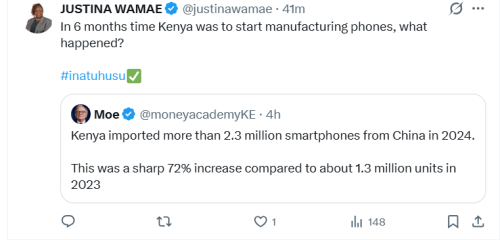
Taking to her X, Wamae’s post sharply questioned the government’s follow-through on its smartphone manufacturing pledge.
“In 6 months, Kenya was to start manufacturing phones, but what happened?” The question directly quoted a viral statistic shared earlier that day: “Kenya imported more than 2.3 million smartphones from China in 2024. This was a sharp 72% increase compared to about 1.3 million units in 2023.”
Wamae’s query highlights lingering frustration over unfulfilled promises to shift Kenya from heavy import reliance to local production of affordable smartphones.
The original ambition dates back to 2022–2023, when President William Ruto and then-ICT Cabinet Secretary Eliud Owalo announced plans for low-cost, locally assembled devices.
Owalo repeatedly assured stakeholders that production would deliver phones at around USD 40 (approximately KSh 5,000–6,000) per unit, aligning with the bottom-up economic transformation agenda to boost digital inclusion and enable transactions for low-income citizens.
Early plans and government support
“Plans are at an advanced stage for Kenya to commence the production of low-cost digital telephone gadgets and other digital devices in the country,” Owalo stated in mid-2023 during a ministry scorecard event.
He emphasised private-sector-led assembly, with the first batch of affordable smart mobile phones expected that year. The government introduced tax incentives via the Finance Act 2023 and partnered with telcos like Safaricom and Jamii Telecommunications, alongside Chinese firm Shenzhen TeleOne Technology, to establish the East Africa Device Assembly Kenya Limited (EADAK) facility in Athi River, Machakos County.
The plant was commissioned in October 2023, launching the Neon Smarta and Neon Ultra models under Safaricom’s branding. Initial targets aimed for millions of units annually, with Owalo noting: “The assembly of the phones and related gadgets is still ongoing, a production that will be undertaken by the private sector.” He added that these devices would help those unable to afford mainstream smartphones access essential services.
Limited progress and rising imports
Despite these steps, progress has fallen short of expectations. By mid-2025, Neon-branded phones captured only a tiny market share (around 0.7%), with consumers citing outdated specs, limited marketing, and quality concerns. Many Kenyans continued favoring imported Chinese brands like Tecno, Infinix, Xiaomi, and Samsung, driving the import surge.
The 2024 import figures over 2.3 million units from China, up 72% from 2023, underscore Kenya’s persistent dependence on foreign suppliers amid growing demand for 4G/5G-capable devices.