Isaac Mwaura lauds WHO for adding sunscreen to essential medicines list to cushion albinism
By Faith Lagat, September 6, 2025Government Spokesperson and Chair of the Albinism Society of Kenya (ASK), Isaac Mwaura, has lauded the World Health Organisation (WHO) for officially adding sunscreen to its Model List of Essential Medicines.
His statement on X, dated September 6, 2025, celebrates a milestone for a community long marginalised by the dangers of ultraviolet (UV) radiation, which significantly increases their risk of skin cancer.
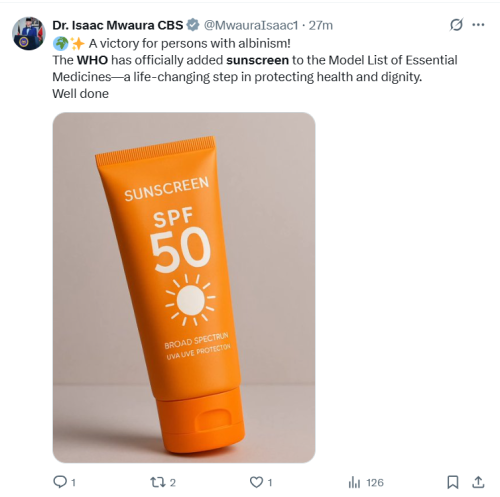
“A victory for persons with albinism! The WHO has officially added sunscreen to the Model List of Essential Medicines—a life-changing step in protecting health and dignity. Well, done,” Mwaura declared.
Campaign for change
The decision, announced on September 5, 2025, reclassifies sunscreen from a cosmetic to an essential medicine, emphasising preventive care for those most at risk.
The campaign was led by Muluka-Anne Miti-Drummond, UN Independent Expert on the enjoyment of human rights by persons with albinism. “For individuals whose lives are defined by vulnerability to ultraviolet radiation, access to sunscreen is life-changing,” Miti-Drummond said during a Geneva session earlier this year.
The advocacy journey began in May 2022 when the Albinism Secretariat approached the WHO Essential Medicines List (EML) Secretariat. Over two years, stakeholders, including the Global Albinism Alliance, the Pierre Fabre Foundation, Beyond Suncare, and later the Africa Albinism Network, strengthened the proposal.
After an initial rejection in July 2023, a revised submission in November 2024, bolstered by an online petition, letters from 20 countries, and personal testimonies like that of skin cancer survivor Clara Maliwa, ultimately persuaded the WHO expert committee to approve the listing in May 2025.
Lifeline for health
In Kenya, the Albinism Society of Kenya has partnered with Linton Cosmetics under Mwaura’s leadership to improve access to sunscreen. The collaboration offers a plant-based product at Sh1,250, half the original Ksh2,500 price, making it more affordable for vulnerable populations. Joyce Gikunda of Linton Cosmetics highlighted the initiative’s focus on quality, health protection, and stigma reduction.
“This dual approach—global recognition and local innovation—provides a lifeline for individuals with albinism, enhancing both health and dignity,” Mwaura said.
Experts note that in sub-Saharan Africa, where up to 90% of persons with albinism die before age 30 due to UV exposure, the WHO decision represents a major step in safeguarding lives.