Inside Kenyans’ recruitment into Russian army and private military groups
By Aloys Michael, February 13, 2026As families in Kenya and across Africa question how their relatives ended up enlisted in the Russian military, a recent report has shed light on an ongoing recruitment drive that began in 2023.
The report by INPACT is from a Swiss-based, open-source investigative non-governmental organisation dedicated to producing in-depth, long-term investigative projects.
The report shows that efforts to enlist Africans into the Russian army and private military companies accelerated in 2023, driven by mounting personnel shortages linked to the prolonged war of attrition in Ukraine.
As battlefield demands intensified, Moscow sought to reinforce both its conventional forces and its expanding military-industrial complex.
At the same time, recruitment initiatives were aimed at sustaining the operations of Russian paramilitary networks overseas, ensuring continued strategic influence across key regions.
“Faced with these constraints, the Kremlin has launched a structured recruitment campaign, targeting historic allies and the Global South, with a particular focus on the African continent,” the report released on Friday, February 13, 2026, says.
This campaign, the report says, aimed to and continued to recruit and deploy African nationals to the Ukrainian theatre, leveraging transnational networks that exploit persistent socio-economic vulnerabilities among the people.
In some states, recruiters exploit political instability and recurring crises to push young nationals to leave their homes.
According to the report, these networks operate through national recruitment agencies that advertise jobs in one country, only for the recruits to eventually find themselves in Russia. In other instances, agencies vaguely claim to be sending workers to unspecified European destinations, masking the true endpoint.
INPACT also notes cases where those already recruited are pressured or incentivised to persuade others to enlist in the Russian army.
It further states that these operations, echoing earlier findings by the Global Initiative Against Transnational Organised Crime (GI-TOC), depend largely on fraudulent employment offers, false promises of education or legal status regularisation, and the use of irregular migration pathways to move individuals across borders.
“INPACT identified several complementary recruitment tactics, including the use of travel agencies operating as logistical intermediaries, the involvement of local pro- Russian individuals and organisations, and recruitment networks based on co- optation, in which former recruits become recruiters themselves,” the report reads.
In some cases, INPACT says the involvement of Russian security services, the Federal Security Service (FSB), was explicitly mentioned.
The firm is believed to be the one coordinating all or part of these recruitment networks, the majority of whose activities are online, primarily on social media, ‘which today constitutes one of the main channels for information and migration planning for young Africans’.
The database lists a total of 1,417 African men who, since 2023, have signed formal contracts to enlist and fight in the Russian Army.
“According to INPACT’s analysis, the recruitment of fighters has been steadily increasing since 2023, rising from 177 in the first year to 592 in 2024 (a figure directly confirmed by Russia at the time) and 647 in 2025.
Govt’s action
Meanwhile, the government has said it will confront Russia over the recruitment of Kenyans into the Ukraine war.
Speaking to an international media station, Foreign Minister Musalia Mudavadi called the practice “unacceptable and clandestine” and said Nairobi had shut down illegal recruiters and would urge Moscow to sign a deal banning the conscription of Kenyan soldiers.
The government estimates that around 200 Kenyans have been recruited to fight for Russia.
The exact number remains unclear, as Nairobi maintains that none of them travelled through official channels.
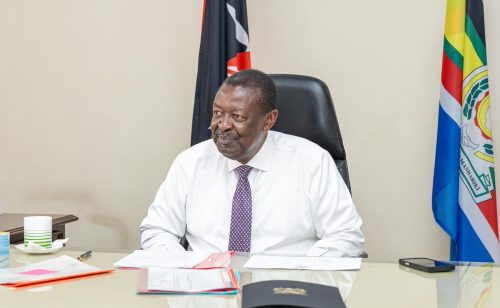
Kenya and Russia have had long relations since independence, literally. So this, in my view, becomes a very unfortunate episode of otherwise very positive and cordial relations between our two countries,” he added.
Mudavadi said that Kenya’s engagement with Russia will focus on curbing illegal recruitment practices, including discussions on visa policy and bilateral labour agreements, excluding military conscription.
He said the Kenyan authorities had closed more than 600 recruitment agencies suspected of duping Kenyans with promises of jobs overseas.
So far, 27 Kenyans who had been fighting in Russia have been repatriated, he said, with authorities providing psychological care to address their trauma and “de-radicalise” them.
It is not clear how many Kenyans have died fighting for Russian forces, and Russia has not formally addressed such reports.
Relatives who have approached the Russian embassy in Nairobi for answers report being turned away.
“Families that we’ve spoken to say they have not been able to bury their loved ones because their bodies are still on the other end,” he said.
“It is difficult because, remember, it depends on where the body has been found. There have been some found in Ukraine, we are also working with the government of Ukraine to try and get the remains of those people repatriated.”