Advertisement
Inside govt proposal to shift civil servants from permanent to contract terms
Friday 27th February, 2026 06:51 PM|

Civil servants are staring at a possible end to permanent and pensionable employment, after the government unveiled plans to shift them to five-year renewable contracts tied to performance.
The proposal, which could affect more than 1,054,425 public workers, is part of a wider reform drive aimed at tightening accountability, improving service delivery, and aligning the workforce with a fast-changing, technology-driven society.
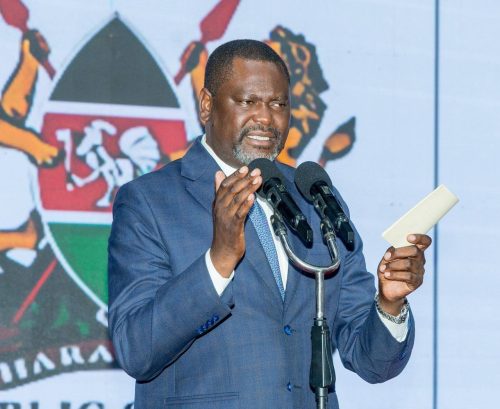
Public Service Cabinet Secretary (CS) Geoffrey Ruku said the policy framework is ready and will soon be tabled before the Cabinet for consideration.
“We are working on public service transformation, which we are doing, and I will later be presenting to the Cabinet committee next week and later present before the full Cabinet,” Ruku said on Thursday, February 26, 2026.
You Might Also Like



Under the proposed changes, public officers will sign five-year contracts, after which their performance will determine whether their terms are renewed.
Results-driven culture
Ruku said the move is aimed at creating a results-driven culture within the public service and ensuring that citizens receive timely and quality services.
He noted that the country’s youthful population is demanding faster, innovative and digitised services, adding that the government must respond by building a public service that is unified, technology-driven and responsive to the needs of citizens.
Ruku spoke during the launch of the Public Service Commission Strategic Plan 2025-29 and the Citizen Service Delivery Charter at KICC, Nairobi.
The five-year plan outlines reforms meant to improve efficiency, accountability, professionalism and citizen-centred governance across ministries, departments and agencies.
The strategy prioritises stronger performance management systems to boost productivity at institutional, departmental and individual levels.

Payroll and pension concerns
This comes days after the Cabinet has approved payroll reforms expected to address long-standing integrity issues within the government’s payroll system and ensure that statutory deductions are applied uniformly across all public entities.
In a Cabinet meeting held at State House, Nairobi, on Tuesday, February 10, 2026, the Cabinet announced that the decision follows a special audit of the 2024/2025 financial year.
In a communique shared by State House Spokesperson Hussein Mohamed, the Cabinet noted that the special audit uncovered serious governance and operational failures within the Government Human Resource Information System-Kenya (HRIS-K).

“The Cabinet has approved far-reaching payroll reforms to address long-standing payroll integrity issues left unresolved by successive administrations and to ensure statutory deductions are uniformly applied at source,” the despatch read in part.
The audit has uncovered widespread payroll anomalies relating to identity records, tax compliance, and bank accounts, compounded by poor system integration and the failure of about 300 state corporations to migrate to HRIS-K.
According to the Cabinet, one particular concern was the finding that 720 system editors altered more than 4.7 million payroll records without audit trails, including instances where staff edited their own records, alongside the absence of basic cybersecurity safeguards.
Likewise, financial irregularities linked to unauthorised payments and excessive salary arrears were identified, while weak disaster-recovery arrangements and expired ICT licences were flagged as major risks to public funds.
In addition, the Cabinet was briefed on immediate stabilisation measures already undertaken and sanctioned a firm reform roadmap.
The measures include mandatory security certification by March 11, 2026, deployment of forensic analytics to guide disciplinary and legal action, a governance reset of HRIS-K, and full integration of a statutory deductions platform.
Author
Latest News



Advertisement
More on News
