Advertisement
IGAD moves to enhance regional capacity on climate-related migration challenges
Tuesday 16th December, 2025 03:48 PM|
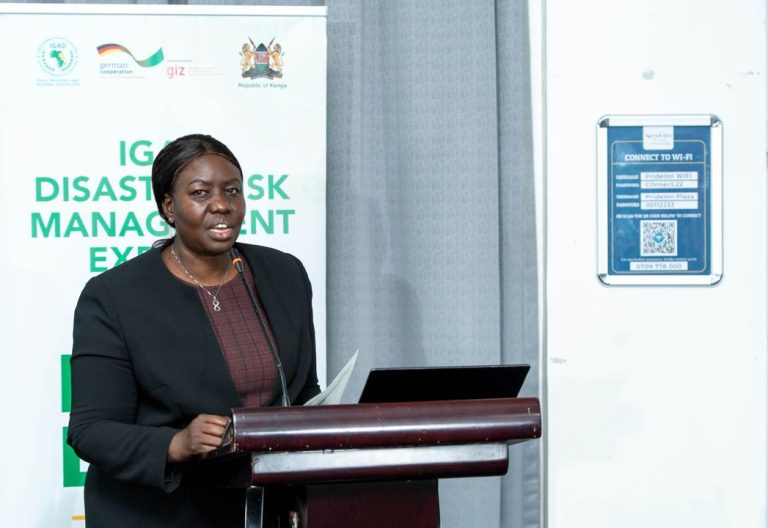
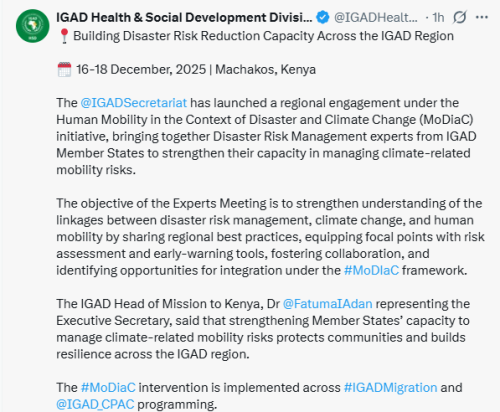
The Intergovernmental Authority on Development (IGAD) has launched a regional engagement aimed at strengthening member states’ capacity to manage climate-related migration and mobility risks under the Human Mobility in the Context of Disaster and Climate Change (MoDiaC) initiative.
The engagement brings together Disaster Risk Management experts from IGAD Member States to deepen understanding of the linkages between disaster risk management, climate change, and human mobility.
The experts’ meeting seeks to promote the sharing of regional best practices, equip national focal points with risk assessment and early-warning tools, foster cross-border collaboration, and identify opportunities for integration under the MoDiaC framework.
Speaking in Machakos on Tuesday, December 17, 2025, IGAD Secretariat Head of Social Development Victoria Anib, noted that rising temperatures, landslides in countries such as Sudan and Kenya, and flooding in other parts of the region are causing widespread disruption and forcing people to move.
You Might Also Like


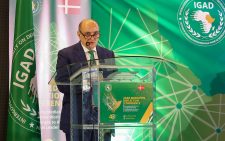
She said the MoDiaC initiative was designed to respond to these realities by strengthening institutional capacity within the IGAD Secretariat while supporting member states to integrate climate-related mobility into national development and disaster management plans.
“Climate change is among the key reasons people are moving across borders. For migration to happen in a dignified and safe manner, we must provide adequate support to those displaced by climate impacts, not just conflict,” Anib said.
Further, she stated that the initiative focuses on building national capacity to incorporate mobility and climate considerations into planning frameworks to ensure coordinated and sustainable responses.
Turning warnings into action
On funding and preparedness, Ahmed Amdihun, Head of the Disaster Risk Management Unit at ICPAC, highlighted a significant gap between climate financing and resources reaching affected communities.
“Globally, what is invested in climate and climate action is far less than what is needed on the ground. Rough estimates show that only about 10 to 15 per cent of funding reaches communities,” Amdihun said.
He emphasised the need to translate climate warnings issued by regional centres and national meteorological departments into early and preventive action to reduce displacement and loss.
“It is time we move from early warning to early action,” he added.
Author
Kenneth Mwenda
Kenneth Mwenda is a business, sports, and politics digital writer with over seven years of experience in journalism, covering breaking news, feature stories, and in-depth analysis across a range of beats.
For inquiries, he can be reached at [email protected]
View all posts by Kenneth MwendaLatest News







Advertisement
More on News