ICJ Kenya pushes for stronger protection of sexual violence survivors in Sudan
By Faith Lagat, June 19, 2026The International Commission of Jurists (ICJ) Kenya Section has called for enhanced protection and justice for survivors of conflict-related sexual violence in Sudan.
In a statement released on Thursday, 19, 2026, ICJ Kenya expressed solidarity with survivors in Sudan and other conflict-affected regions while renewing calls for accountability, reparations, and expanded support services.
The statement was issued as the world marked the United Nations’ International Day for the Elimination of Sexual Violence in Conflict.
ICJ Kenya noted that Sudan’s conflict, now in its third year since 15 April 2026, continues to expose civilians to severe violations, particularly women and girls.
“As the United Nations commemorates the International Day for the Elimination of Sexual Violence in Conflict, the ICJ- Kenya stands in solidarity with survivors of conflict-related sexual violence in Sudan and across the world, while renewing its call for accountability, justice, and reparations for victims and survivors of these grave violations,” read the statement in part.
Conflict-related sexual violence
The organisation cited reports from the United Nations, the African Union/ACHPR Fact-Finding Mission, humanitarian agencies, civil society organisations, and survivors documenting extensive violations in Sudan.
These include gang rape, sexual slavery, forced marriages, sexual exploitation, rape, and other forms of gender-based violence affecting women, girls, men, and boys.
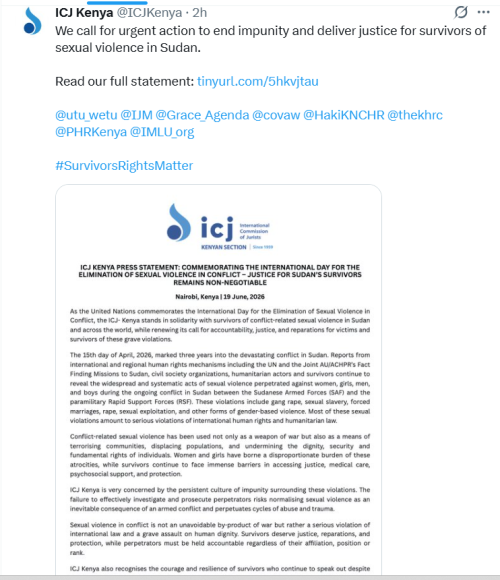
ICJ Kenya stated that sexual violence has been used both as a weapon of war and as a tool of intimidation, displacement, and community destabilisation.
It further noted that survivors continue to face barriers in accessing justice, medical services, psychosocial support, and protection mechanisms.
ICJ on survivor protection
The rights body expressed concern over what it described as a persistent culture of impunity, warning that failure to investigate and prosecute perpetrators risks normalising sexual violence in conflict situations.
“The failure to effectively investigate and prosecute perpetrators risks normalising sexual violence as an inevitable consequence of an armed conflict and perpetuates cycles of abuse and trauma,” continued the statement.
ICJ Kenya emphasised that sexual violence in conflict is a violation of international law and not an unavoidable outcome of war, calling for stronger accountability mechanisms regardless of rank or affiliation.
The organisation also acknowledged the resilience of survivors who continue to speak out despite risks, noting that their testimonies are critical in exposing violations and advancing justice processes.