Advertisement
How Utumishi Girls’ Academy tragedy exposes govt’s ignorance on school safety
Friday 29th May, 2026 09:14 PM|

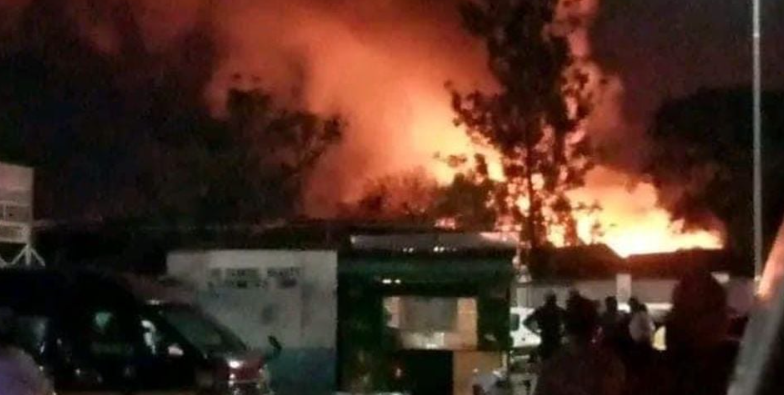
When flames tore through the Meline Waithera Dormitory at Utumishi Girls Senior Secondary School in Gilgil on the night of May 28, 2026, trapping students behind a locked emergency exit, Kenya was once again forced to confront a horrifying truth:
School fires in the country are no longer isolated tragedies; they are evidence of systemic failure.
Sixteen girls were burnt beyond recognition near the emergency exit they had desperately tried to use. Survivors told investigators that while some students escaped through the main entrance, others were trapped because the emergency door was locked.
The Directorate of Criminal Investigations (DCI) has since arrested eight students as persons of interest in what detectives suspect was a planned arson attack.

You Might Also Like



Investigators say the fire started near the main entrance before rapidly engulfing the upper floor of the two-storey dormitory that housed 135 double-decker beds.
But beyond the criminal investigation lies a deeper and more disturbing question: why, years after repeated school infernos and multiple government warnings, are Kenyan schools still death traps?
A six-year-old performance audit report by the Office of the Auditor-General appears to hold part of the answer.
The report, titled Performance Audit Report on Fire Safety Preparedness in Secondary Schools, reveals that schools lacked basic fire safety infrastructure, emergency preparedness, proper evacuation systems and effective oversight.
“The audit revealed that implementation of fire safety measures put in place by the Ministry of Education has faced several challenges such as inadequate infrastructure, limited training on fire safety preparedness, insufficient guidance and counselling in schools,” the report stated.
“Secondary schools were not adequately prepared to handle fire incidents.”
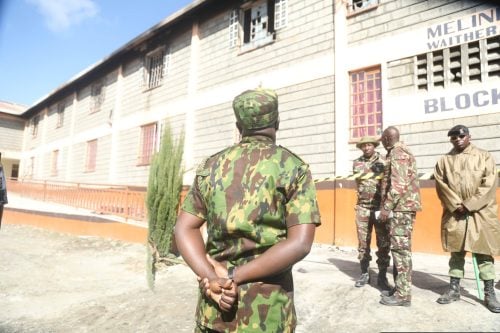
The findings now read like a prophecy of the Utumishi tragedy.
The audit report
The report established that none of the 42 sampled schools had posted evacuation maps on buildings as required under the Safety Standards Manual for Schools in Kenya.
It also found that some schools lacked functional fire assembly points, while others had emergency areas blocked by fences and barbed wire.
“Lack of a functional fire assembly point is likely to lead to confusion on where to assemble in the event of a fire, and some students and staff might end up being trapped in buildings, resulting in loss of lives or serious injuries,” the auditor warned.
More chillingly, the audit revealed that many dormitories violated basic architectural safety standards.

“Some schools did not have doors at each end of the dormitory or clearly labelled emergency exits,” the report stated, adding that windows reinforced with metal grills and inward-opening doors could “hinder evacuation in the event of fire, leading to injuries and loss of lives.”
At Utumishi Girls, investigators say the emergency exit was locked from the outside or inaccessible during the inferno, precisely the kind of danger the audit warned about years ago.
The report further exposed severe congestion in schools caused partly by the government’s push for 100 per cent transition from primary to secondary education without matching infrastructure expansion.
According to the audit, 30 out of 40 schools visited had exceeded their approved student capacity, with one school accommodating 519 students beyond its registered limit.
The audit also found that 34 boarding schools had double-decker beds without the required spacing, while six schools had introduced triple-decker beds.
“Schools are therefore congested, and this increases the risk of loss of lives in the event of a fire,” the report warned.
The description mirrors the Utumishi dormitory, where 135 double-decker beds occupied a single upper floor.

School fire crises
The tragedy has revived painful memories of the Hillside Endarasha Academy fire in Nyeri County in September 2024, where 21 boys died after flames engulfed a crowded dormitory housing more than 150 learners.
Investigations and witness accounts later raised concerns about overcrowding, emergency preparedness and the speed of evacuation.
Like Utumishi, Endarasha briefly triggered national outrage and promises of reforms.
Yet the Auditor-General’s report suggests that even before Endarasha, the government already knew schools were ill-equipped to prevent or manage fire disasters.
The audit found that 71 per cent of sampled schools lacked safety sub-committees responsible for fire preparedness, while only two out of 42 schools had invited county fire officers for fire drills and demonstrations.
“Schools were not ready to combat fire incidents as they lacked comprehensive training in fire safety preparedness,” the report stated.
The report also exposed glaring failures in guidance and counselling systems despite repeated links between school fires and student unrest or indiscipline.
“Most school fires are attributed to indiscipline issues,” the audit noted.

However, it found that 31 out of 42 sampled schools lacked qualified guidance and counselling teachers.
The ministry’s own guidance and counselling department had only two staff members at the national level.
“Guidance and counselling were not working as intended,” the auditors observed.
That finding now carries added significance as detectives investigate claims that the Utumishi fire may have been deliberately planned.
Perhaps the most devastating indictment in the audit was directed at government oversight itself.
The report found that Quality Assurance and Standards Officers, the officials tasked with monitoring school safety, were severely understaffed, underfunded and unable to conduct regular inspections.
“At least half of the schools visited had been assessed at least twice in the last five years,” the report stated, attributing poor monitoring to a shortage of staff, “inadequate resources and lack of comprehensive assessment tools.
Six years later, those recommendations remain largely unimplemented. And now, another generation of students has paid the price.
Kenya’s history of deadly school fires stretches back decades, from Kyanguli Boys High School in 2001, where 67 students died, to Moi Girls Nairobi in 2017, where 10 girls perished, to Hillside Endarasha in 2024, and now Utumishi Girls in 2026.
Each tragedy has been followed by public mourning, investigations and promises of reform.
Yet the recurring patterns locked exits, overcrowded dormitories, inadequate emergency systems and weak oversight continue to surface with disturbing consistency.
The Utumishi fire has therefore exposed more than a possible act of arson.
It has exposed a government that has repeatedly received warnings about school safety failures but failed to act decisively.
For the families mourning daughters burnt beyond recognition at a locked emergency exit, the greatest tragedy may not only be the fire itself, but the fact that the warning signs had long been known.
Author
Latest News







Advertisement
More on News