Govt moves to address conflicts of residents living near forests
By Kiprono Keileb, March 13, 2026The government has reiterated its commitment to resolving long-standing disputes involving communities living next to forested areas while ensuring environmental conservation. Officials appeared before the National Assembly to provide clarity on how affected settlements will be regularised through lawful procedures.
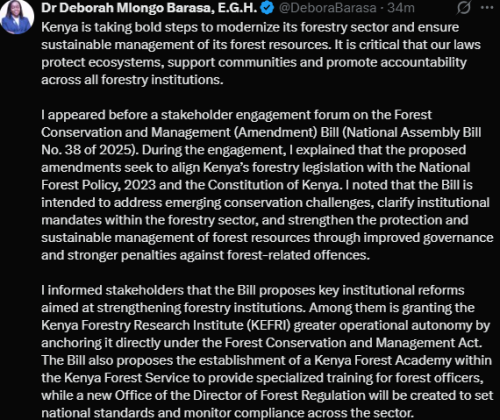
In a statement shared on X on Friday, March 13, 2026, the Cabinet Secretary for Environment, Climate Change and Forestry, Deborah Barasa, outlined the Ministry’s approach to addressing these claims and explained the processes guiding boundary variations in key forest areas.
“The Government remains committed to resolving long-standing land issues affecting communities living adjacent to forest areas while safeguarding the integrity of Kenya’s forest ecosystems. Addressing these matters through lawful and transparent processes is essential in promoting both environmental conservation and social stability,” the statement reads.

CS Barasa detailed the areas under review, emphasising that several petitions had already been submitted to Parliament seeking the regularisation of settlements within Turbo, Mount Elgon, and Kakamega Forests.
“I appeared before the Departmental Committee on Environment, Forestry and Mining of the National Assembly to make submissions on a petition concerning the proposed variation of boundaries affecting sections of Turbo Forest in the Manzini area, Mount Elgon Forest in the Chepyuk area and Kakamega Forest in the Shiru and Shaviringa areas,” the CS statement reads.
The ministry further explained that a technical team had been constituted to assess petitions based on resettlement approvals, the absence of legal disputes, and the degree of settlement already present.
“During the presentation, I explained that the Ministry had earlier submitted a petition to the National Assembly seeking the determination of several long-standing public forest land claims. The Ministry received petitions from communities requesting the regularisation of settlements within certain forest areas,” the statement reads.
Recommendations from the technical review were forwarded to the Kenya Forest Service Board, which approved the move to regularise settlements before the Cabinet gave final approval for formal proceedings.
“A technical team was therefore constituted to analyze the petitions using specific criteria, including previous Cabinet approvals for resettlement, absence of pending court cases and the extent of settlement in the affected areas,” Barasa stated.
The CS reassured the committee that Environmental Impact Assessments were completed and public participation conducted to ensure transparency and compliance with the Forest Conservation and Management Act.
“Following the review, the recommendations were forwarded to the Kenya Forest Service Board, which approved the proposal to proceed with the regularisation process. The matter was subsequently presented to Cabinet, which approved for the Ministry to initiate the formal petition process,” she wrote.

CS Barasa also pointed out the historical significance of the areas, noting some settlements have existed for decades and already host public infrastructure, stressing that formalising boundaries will curb illegal activities and land speculation.
“I further informed the Committee that Environmental Impact Assessments were conducted for the areas proposed for boundary variation in accordance with the Forest Conservation and Management Act. The process also included stakeholder consultations and public participation to ensure transparency and compliance with the law,” the statement reads.
Resolving the forest boundary disputes, the ministry said, is critical in balancing community needs with conservation, ensuring Kenya’s forest ecosystems remain protected while residents’ claims are lawfully addressed.
“Members of the Committee were also briefed on the historical background of the forest areas, noting that some settlements date back several decades and already host established communities and public infrastructure. Resolving the status of these areas will help curb degradation, illegal activities, and land speculation while promoting conservation of the remaining forest ecosystems,” the statement reads.
The MPs, however, rejected the proposal to de-gazette specific forest areas in the country.