Advertisement
Govt bans parallel drug imports to ensure safe quality medical products
Thursday 02nd July, 2026 08:59 AM|

Kenya has banned parallel importation of medicines and other health technologies in a move aimed at strengthening regulation and improving patient safety.
Health Cabinet Secretary Aden Duale announced on Thursday, July 2, 2026, that the government has stopped all parallel imports of medical products to ensure tighter oversight of drugs entering the country. He said the decision targets substandard and unregulated products that have raised concern in the health sector.
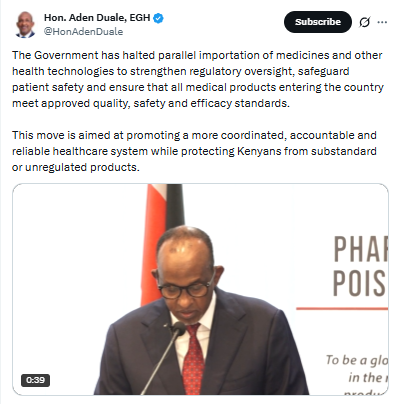
“The Government has halted parallel importation of medicines and other health technologies to strengthen regulatory oversight, safeguard patient safety and ensure that all medical products entering the country meet approved quality, safety and efficacy standards,” Duale said in a post on X.
He added that the move will help build a more coordinated and accountable healthcare system. According to him, the government wants to protect Kenyans from unsafe medical products circulating in the market.
You Might Also Like



“We decided to clean the market, and we stopped all parallel imports, which has caused havoc in our country,” he said in a video. “Since October 1st, 2025, no single parallel import has been approved for importation. And I don’t think they will also do it again.”
Parallel importation refers to the import of medicines through unofficial or alternative channels, often outside agreements with manufacturers or authorised distributors. The government says such channels have made it harder to control quality and trace the origin of some medical products.
Duale said Kenya will now rely on regulated supply chains that allow full accountability from manufacturers to end users. He stressed that the policy change is meant to reduce risks linked to counterfeit and substandard drugs.
Stronger drug safety oversight
At the same time, the government says it has stepped up enforcement against unsafe products. Since January 2025, the Pharmacy and Poisons Board has coordinated the recall of 58 substandard medical products. It has also issued 14 alerts on falsified medical products.
Duale said these figures show stronger surveillance rather than a worsening crisis.
“Some may interpret these numbers as evidence of a worsening problem. I take a different view,” he said. “These demonstrate a regulator that is more vigilant, more transparent, and more effective in identifying risk and taking decisive action while informing the public.”

He said the Pharmacy and Poisons Board is now more active in monitoring medicines on the market and responding quickly when risks emerge.
The government is also working on a digital system to track medicines across the supply chain. The Digital Health Agency and the Pharmacy and Poisons Board are piloting a Track and Trace System for medicines and other health products.
The system will allow regulators to follow every product from manufacture to distribution and finally to the patient. Authorities say this will help detect counterfeit drugs and improve accountability in the pharmaceutical sector.
Duale said the pilot phase will run in July 2026, with plans to roll out the system fully from August 1, 2026 if successful.
“When that pilot is completed in July and it goes live on 1st August, every medicine dispersed in our country can be traced from the pharmacist to the distributor, wholesaler, all the way to the manufacturer,” he said.
Author
Kenneth Mwenda
Kenneth Mwenda is a business, sports, and politics digital writer with over seven years of experience in journalism, covering breaking news, feature stories, and in-depth analysis across a range of beats.
For inquiries, he can be reached at [email protected]
View all posts by Kenneth MwendaLatest News







Advertisement
More on News