Advertisement
Global Peace Index 2026: Horn of Africa wars now form one world’s dangerous conflict system
Saturday 13th June, 2026 11:35 PM|

The wars raging across Sudan, Ethiopia, Somalia and South Sudan are no longer isolated crises.
Instead, they have merged into what they describe as one of the world’s most dangerous and interconnected conflict systems, creating a growing security threat for the entire East African region.
That is the stark warning contained in the newly released Global Peace Index (GPI) 2026, which argues that the Horn of Africa has evolved into a single conflict cluster linked by refugee flows, illicit trade networks, arms trafficking, gold smuggling, proxy actors and competition for control of strategic Red Sea routes.
“The Horn of Africa is no longer a set of separate conflicts. The conflicts in Sudan, Ethiopia, Eritrea, South Sudan and Somalia are now interlocked through every channel that causes conflicts to spread,” the report states.
You Might Also Like



The finding represents a major shift in how security experts view one of Africa’s most volatile regions.
For years, policymakers treated Sudan’s civil war, Somalia’s insurgency, Ethiopia’s internal conflicts and South Sudan’s political instability as distinct challenges requiring separate solutions. The Global Peace Index argues that the approach is increasingly outdated.

Instead, researchers say the region now functions as a connected ecosystem of conflict where instability in one country rapidly affects neighbouring states.
According to the report, there are now eight major conflict clusters globally, but the Horn of Africa stands out because of the sheer number of overlapping drivers that are fuelling violence across borders.
Sudan’s civil war has become a key example that the report describes as the world’s worst humanitarian crisis, with more than 12 million displaced people and conflict-related deaths continuing to rise.
“The Sudan conflict has become self-financing through gold revenues,” the index notes, warning that the growing profitability of conflict is making peace harder to achieve.
As millions flee violence, refugee flows are placing pressure on neighbouring countries, particularly South Sudan, Ethiopia and Uganda.
At the same time, illicit networks transporting weapons, gold and other resources increasingly operate across borders, creating new security challenges for governments throughout the region.
The report argues that these dynamics are creating a cycle in which conflicts reinforce one another rather than remaining contained within national borders.
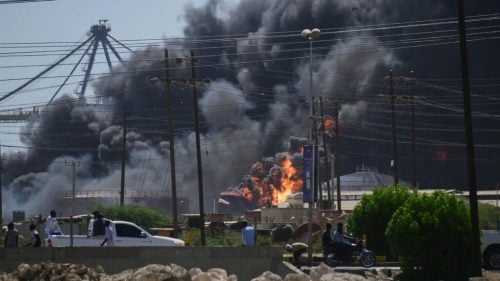
Red Sea new battleground?
Another factor binding the region together is growing competition around the Red Sea.
Researchers point to rising geopolitical tensions involving Gulf states, global powers and regional actors seeking influence over strategic ports and maritime trade routes.
“The Iran war is a force multiplier for the spread of conflict,” the report says, adding that instability around the Red Sea is amplifying existing vulnerabilities across the Horn of Africa.
The Red Sea handles a significant share of global trade, making it one of the world’s most strategically important waterways.
Countries including Sudan, Eritrea and Somalia have become increasingly important in regional power struggles, with external actors seeking military, economic and political influence along the coastline.

For Kenya, the report raises an uncomfortable question: How long can the country remain insulated while every immediate northern neighbour faces some form of conflict or instability?
To the north lies South Sudan, ranked among the world’s least peaceful countries. To the northwest, Sudan remains engulfed in civil war. Ethiopia continues to face internal tensions, while Somalia remains locked in a long-running battle against Al-Shabaab militants.
Although Kenya has avoided large-scale conflict, the report suggests geography alone makes it vulnerable to regional spillovers.
As East Africa’s largest transport and logistics hub, Kenya could face increasing pressure from refugee movements, cross-border criminal networks, terrorism risks and disruptions to trade corridors.
Nairobi is also a critical diplomatic centre for regional peace efforts, meaning prolonged instability across the Horn is likely to place additional demands on Kenya’s political and security institutions.
Author
Latest News








Advertisement
More on News