Global health gains slow as maternal and child deaths remain alarmingly high
By Faith Lagat, August 24, 2025Global health progress is faltering, with maternal and child mortality rates still alarmingly high despite decades of improvement, according to the latest United Nations Sustainable Development Goals (SDG) report.
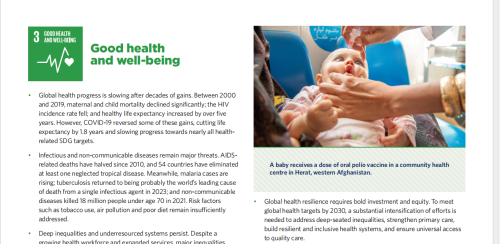
While significant strides were recorded between 2000 and 2019—including a drop in maternal and child deaths, reduced HIV incidence, and a rise of more than five years in healthy life expectancy—the COVID-19 pandemic reversed some of these gains.
“Global Health Gains Stall as Maternal and Child Mortality Rates Remain High Despite decades of progress, global health improvements are faltering, with maternal and child mortality rates still alarmingly high,” according to the United Nations Sustainable Development Goals (SDG) report.
Global life expectancy fell by 1.8 years, with progress toward nearly all health-related SDG targets stalling.
The report highlights persistent inequalities, underfunded health systems, and the urgent need for bold investments if the 2030 health targets are to be achieved.
Maternal deaths
The global maternal mortality ratio (MMR) fell from 228 deaths per 100,000 live births in 2015 to 197 in 2023. However, 260,000 women still lost their lives during pregnancy and childbirth last year—far from the SDG target of reducing the ratio to 70 by 2030. Achieving this goal would require an unprecedented annual reduction rate of 14.8 percent.
Disparities remain stark. Low-income countries recorded an MMR of 346, compared to just 10 in high-income nations. Conflict-affected regions fared even worse, with a ratio of 504. Sub-Saharan Africa and Southern Asia together accounted for 87 percent of global maternal deaths.
The World Health Organization (WHO) estimates that one woman dies every two minutes due to preventable complications, with 287,000 maternal deaths recorded in 2020 alone. Leading causes include haemorrhage, hypertensive disorders, and obstructed labour. “Understanding why pregnant women and mothers are dying is critical,” said Dr. Pascale Allotey of WHO, stressing the need for equitable access to quality healthcare.
Child mortality
Child survival has improved, but not at the pace required to meet global targets. The under-5 mortality rate declined from 44 to 37 deaths per 1,000 live births between 2015 and 2023, marking a 16 percent reduction. Despite this, 4.8 million children under the age of five died last year.
The disparities are glaring. Sub-Saharan Africa recorded 69 deaths per 1,000 live births, 18 times higher than Australia and New Zealand. Progress has slowed in recent years, with the annual rate of reduction for under-5 and neonatal deaths dropping sharply since 2015. WHO warns that 60 countries, most of them in Africa, must accelerate interventions if the SDG child survival targets are to be achieved.
Urgent action
Global health leaders stress that preventable maternal and child deaths can be addressed with stronger investments in primary healthcare, universal access to skilled birth attendants, and equitable distribution of resources. WHO has launched a 2024 Global Roadmap for Postpartum Haemorrhage and supported a World Health Assembly resolution to tackle maternal deaths.
As the world prepares to mark World Health Day 2025, which will focus on maternal and newborn health, WHO is calling for urgent action to close equity gaps. Ensuring every mother and child has access to skilled care and holistic support, the agency says, could save millions of lives and restore momentum toward the 2030 health goals.