Advertisement
Farmers set to reap big from millet variety in Makueni
Tuesday 19th May, 2020 12:00 AM|
Mwangi Mumero
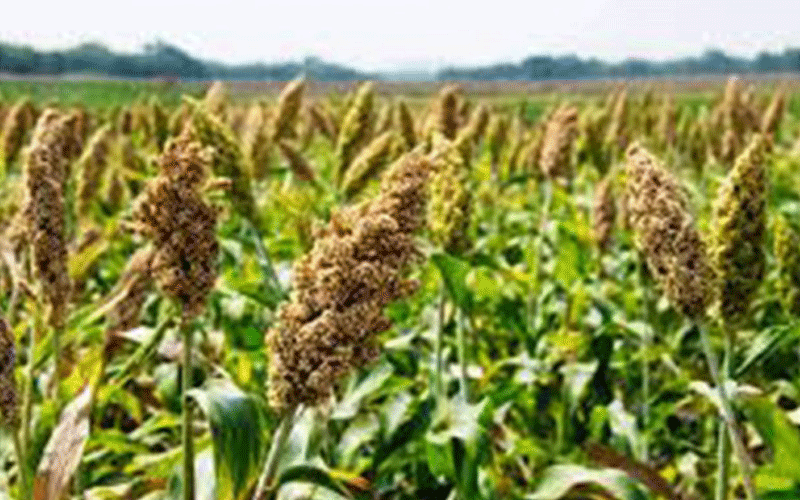
DROUGHT: International Crop Research Institute for the Semi-Arid Tropics (ICRISAT) has introduced a new snapping variety for finger millet which is easy to harvest to farmers in Makueni County.
The variety EUFM 502 has a brittle stem allowing farmers to harvest it by snapping the plant at the neck-easing on labour, according to experts.
It is among the improved varieties introduced to the region in a project aimed at raising yields of semi-arid crops to boost household incomes.
“The improved varieties not only withstand the dry weather but are also resistant to diseases and have higher nutritional value. They give better yields,” said Gelvasio Mukono, ICRISAT’s field officer coordinating activities in Makueni.
Known as the Accelerated Value Chain Development (AVCD) project, this drought crops initiative is funded by the United States Agency for International Development (USAid).
Under the project, farmers have obtained improved varieties of sorghum, groundnut, green gram, finger millet, pearl millet, pigeon pea and cowpea- crops that fare well in the arid conditions prevalent in Makueni and most part of the country.
Over 144,000 farming households have been provided with 1,000 tonnes of improved high-quality seeds of drought-tolerant cereals and legumes, resulting in over 60,000 ha of land being covered by improved seeds in Eastern Kenya.
More than 144,000 farmers have been trained in good agricultural practices for higher productivity, including over 50,000 farmers who received training on effective post-harvest handling techniques.
Farmers were also enabled to access quality seed unlike before when they used recycled seeds or grain purchased from the market.
With green grams being an important food and cash crop in Kitui and Makueni counties, farmers have taken up the new ICRISAT introduced varieties boosting their production.
“The new variety and good farming techniques have improved my yields from 200 kg per acre to 600 kg per acre.
Training on spacing, intercropping and post-harvesting handling has boosted our yields and incomes,” said Betty Bondo, one of the farmers from Mulala Ward in Makueni county.
Like other farmers in the region, Bondo has increased the acreage under green grams from three acres to 20 acres.
To boost to green gram producers in Kenya, India promised in 2018 to be importing at least 100,000 tonnes of the crop annually from farmers.
Author
People Reporter
View all posts by People ReporterLatest News








Advertisement
More on News