Advertisement
Electoral agency in dire straits as State blocks donor funds
Wednesday 22nd December, 2021 04:00 AM|
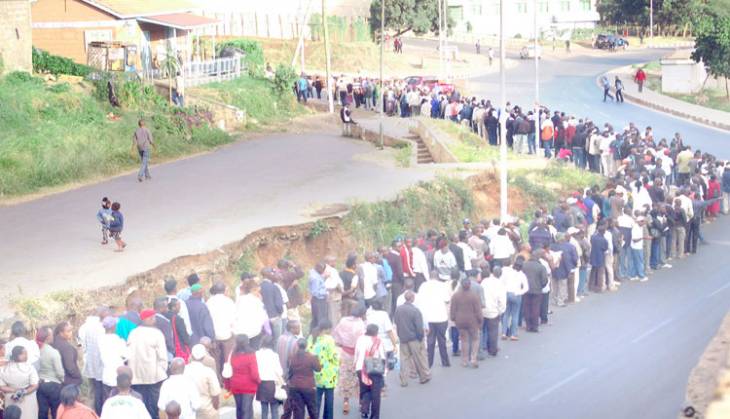
A decision by the government to limit the influence of foreign funding on Kenyan elections is affecting preparations for next year’s General Election with the Independent Electoral and Boundaries Commission (IEBC) facing a consequential cash crunch.
With a deficit of Sh14.5 billion, the electoral agency, and other players in the electoral process, is reeling from the effects of the government decision to stop direct financing of electoral systems in the country.
IEBC had anticipated that the government would give it an additional Sh7 billion with the deficit of the Sh7.5 billion being raised from donor funding.
Players in the electoral process are now expressing reservations about the state of preparedness for next year’s General Election that is eight months away as the donor taps remain switched off as a result of the government move.
Several donors such as the United Nations Development Programme (UNDP), United States Agency for International Development (USAID), Britain’s Department for International Development (DFID), International Foundation for Electoral Systems (IFES), the European Union and Scandinavian countries that have perennially funded Kenyan elections are said to be holding onto their money as they await government consent.
In the 2013 and 2017 elections, donors were responsible for funding voter registration, civic education, election security, technology acquisition, training of IEBC staff, police and legal reforms.
In the countdown to the 2017 General Election, UNDP, which has been one of the main financiers of Kenya’s election process and systems, supported the country to the tune of Sh2.6 billion with institutions such as IEBC, office of the Registrar of Political Parties, the Judiciary, civil society and the media benefitting.
Civic education
“The ban on direct financing of IEBC and civil societies has adversely affected our preparedness for the 2022 General Election as a number of programmes that are crucial to the exercise have been put on hold.
We are aware that the donors are ready to give us money, but the government has not given them that greenlight,” says Mulle Musau of the Election Observation Group (Elog) – Kenya.
Mulle disclosed that several civil society organisations have had to stop their activities due to lack of funds.
Mulle blames lack of funding from donors to enable IEBC and civil societies to undertake a vigorous civic education and advocacy for the recent low voter registration and warns that should the taps remain dry, the country could witness the lowest voter turn out on August 9, 2022.
Sources within IEBC say the agency was unable to engage the services of mobilisers to create awareness and interest in the 290 constituencies during the recent voter registration as a result of inadequate funding.
The government had in 2020, through Foreign Affairs Cabinet Secretary Raychele Omamo, written to donors directing them “to put on hold their funding and that if we need help, we will let you know”.
The letter directed donors to channel all their funding through the National Treasury with a notification to the Ministry of Foreign Affairs on its intended purpose and desired end result.
“This will be communicated officially through the Ministry of Foreign Affairs,” said the memo to all diplomatic missions, accredited international organisations and other foreign entities domiciled in Nairobi.
Omamo told donors that the“state would bear the sole prerogative to co-ordinate election-related needs and resource gaps that may call for partnership”.
Since then donors have been left hanging in the balance, with no word forthcoming from the government on whether the donors can loosen the purse strings.
Sources at the ministry hinted that the decision was arrived at out of the belief that foreign donors have previously interfered in Kenya’s electoral process.
Skewed outcomes
“Kenya is cognisant of recently orchestrated events and experiences meant to interfere and sometimes lead to skewed national election outcomes globally,” Omamo had warned in her letter, igniting debate that the government could be anticipating some unnamed foreign interference in the 2022 General Election.
And in a move seen as the State’s determination to keep external donors out of the electoral process, the government had in October formed a multi-agency team chaired by Justice Martha Koome to oversee poll preparations. IEBC later withdrew its participation in the team citing alleged interference with her constitutional independence.
Although IEBC chairman Wafula Chebukati declined to comment on the effects of the government move, sources at the electoral agency intimated to People Daily that it “impacted negatively on its programmes”.
“The gap left by the donors is big and is being felt both within and outside IEBC. There are several programmes that we have not been able to effectively undertake due to lack of funds.
Apparently IEBC is running on a shoestring budget,” said a senior official at the electoral agency who declined to be named due to the sensitivity of the matter.
In a letter dated September 17, 2021, to Foreign Affairs Principal Secretary Macharia Kamau, Chebukati claimed the decision to starve IEBC of donor funds, “has not only forced it into a cash crisis, but is also out to compromise her independence”.
“We reiterate the commission’s independence in the performance of its functions, which shall not be subject to the control of any authority as envisaged in the Constitution,” Chebukati warned.
The IEBC boss further told the PS that the move was unwarranted since the electoral agency had always accounted for funds received from “internal and external donors”.
“We need to train our new staff, particularly the commissioners, the police and Judiciary staff. But we cannot effectively do this without adequate funding,” said an IEBC source.
The IEBC official warned that it would be “almost impossible” to run most of the 2022-related activities without donor funding and urged the government to reconsider its stand “before it is too late.”
According to Musau, some of the programmes affected as a result of the ban on donor funding include stoppage of voter education that is a critical component in the electoral process; advocacy where members of civil society push for reforms and inability to undertake effective monitoring and observation of elections.
“One needs good funding to post observers and monitors to most of the polling stations. But with this ban in place, our hands will remain tied on what to do.
The absence of observers in several polling stations is likely to impact the transparency and fairness of the polls,” says Musau.
Addressing a media stakeholder meeting in Mombasa in August, Chebubaki disclosed that the National Treasury had allocated IEBC Sh26.3 billion out of a total of Sh40.2 billion that was required.
“We are left with a deficit of Sh14.577 billion. It is worth noting that the Sh40.917 budget requirement is the bare minimum as per the electoral activities in the Election Operations Plan,” Chebukati stated.
Author
Mathew.Ndungu
View all posts by Mathew.NdunguLatest News
Advertisement
More on News