East Africa urged to tackle surge in illicit health products
By Faith Lagat, July 10, 2025Pharmacy and Poisons Board (PPB) CEO Fred Siyoi has urged East African nations to unite in the fight against counterfeit and substandard medicines, calling for stronger regional cooperation to secure pharmaceutical supply chains.
Speaking at the Operation African Star workshop in Nairobi on Thursday, July 10, 2025, Siyoi warned that the growing presence of illicit health products poses a serious risk to public safety.
“Our mandate is to strengthen pharmaceutical supply chains and enhance regional cooperation to combat the rising threat of illicit health products,” he posed.
His remarks come amid fresh concerns over medicine quality, with the World Health Organisation estimating that 1 in 10 medical products in low- and middle-income countries fails quality control tests.
Siyoi pointed to Kenya’s ongoing pilot of the Pharmaceutical Authentication and Traceability Program (PATP) as a model for the region. The initiative uses digital tracking and artificial intelligence to verify the authenticity of medicines and improve supply chain transparency.
“We must build on the success of Operation African Star 1 by fostering joint action across borders,” he said, noting that the PATP has helped reduce the circulation of counterfeit drugs by up to 15% in some pilot areas, according to a 2023 Pharmaceutical Research study.
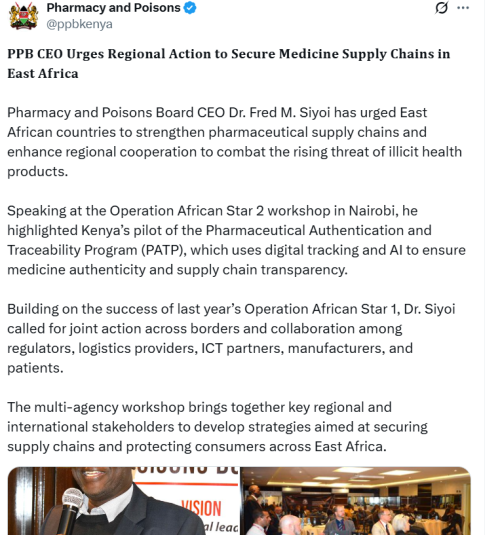
The workshop brought together regulators, ICT experts, logistics providers, manufacturers, and international stakeholders to develop coordinated strategies aimed at disrupting illicit trade in health products. The multi-agency meeting comes at a time when the region is still grappling with supply chain vulnerabilities exposed by the COVID-19 pandemic.
A 2022 Lancet study reported a 20% increase in counterfeit medical products during the pandemic, highlighting the urgency of Siyoi’s message.
“This is a collective responsibility,” he said. “Regulators, logistics partners, manufacturers, and even patients all have a role to play in safeguarding our health systems.”
This year’s workshop signals a shift toward integrating advanced technology in regional health systems.
Regional bodies such as the East, Central, and Southern Africa Health Community are also exploring collaborative procurement and data-sharing frameworks to address the issue.
As the threat of illicit medical products continues to grow, health authorities across East Africa are under pressure to act. Siyoi’s call for unity and innovation presents an opportunity to redefine how the region responds to this persistent challenge.