EACC salary freeze: How Kenya will enforce wealth declarations for civil servants
By Aloys Michael, July 17, 2026The Ethics and Anti-Corruption Commission (EACC) plans to introduce administrative measures that could see public officers who fail to submit mandatory wealth declarations have their salaries withheld until they comply, under proposed regulations implementing the Conflict of Interest Act, 2025.
The proposed enforcement framework is designed to improve compliance with Kenya’s wealth declaration regime by introducing immediate administrative sanctions alongside existing criminal penalties.
It targets public officers who fail to file declarations of their income, assets and liabilities within the timelines prescribed by law, helping the EACC detect unexplained wealth, conflicts of interest and illicit enrichment in the public sector.
The proposals come as Kenya intensifies anti-corruption reforms backed by the International Monetary Fund (IMF) and the World Bank, with the EACC reporting that corruption costs the country an estimated Ksh608 billion annually, or about 7.8 per cent of Gross Domestic Product (GDP).
During the 2023/24 financial year, the Commission recovered Ksh2.9 billion in unexplained or corruptly acquired assets and prevented a further Ksh2.9 billion in potential losses.
How the EACC salary-freeze plan will work
According to the proposed administrative mechanisms under the Conflict of Interest Act, public officers who fail to submit mandatory wealth declarations would first receive compliance notices and warnings before the EACC recommends administrative action, including withholding salaries until the declarations are filed.
The salary-withholding proposal would supplement existing criminal sanctions under the Conflict of Interest Act rather than replace them.
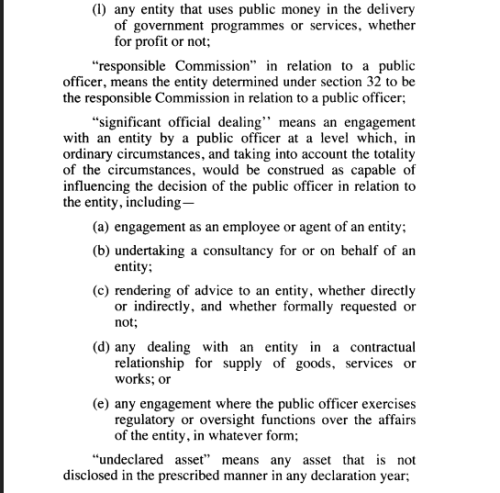
“The Commission shall, within twelve months after the commencement of this Act, develop and publish in the Gazette, administrative mechanisms for the implementation of the requirements of this Part,” the Act reads in part.
It requires every public officer to declare not only their own financial affairs but also those of their immediate family.

“Every public officer shall submit, a declaration of his or her income, assets and liabilities and the income, assets and liabilities of his or her spouse and dependent children under the age of eighteen years.”
The declarations cover income, assets, liabilities, jointly owned property, foreign assets and any material changes in wealth. Where reasonably ascertainable, separated spouses are also covered under the declaration requirements.
Wealth declaration and penalty
The law requires public officers to submit wealth declarations within 30 days of assuming office, every two years during their tenure, and within 30 days after leaving public service.
“A public officer shall, once every two years within the period of service, submit a declaration relating to the financial affairs of the public officer,” the legislation states.
However, Failure to comply remains a criminal offence under the Conflict of Interest Act.
“A public officer who fails to submit any information required under this Act, within the prescribed period, commits an offence.”

Upon conviction, offenders may face a fine of up to Ksh1 million, imprisonment for up to one year, or both. Under the proposed EACC administrative framework, non-compliant officers could also have their salaries withheld until they meet the declaration requirements.
The EACC says wealth declarations are a critical anti-corruption tool because they enable investigators to compare an officer’s known lawful income with their accumulated assets and identify potential conflicts of interest.
“The Commission’s statutory functions include to analyse, seek for clarification and verify conflict of interest disclosures and instituting proceedings for forfeiture of undeclared or unexplained assets.”
The Commission has consistently argued that illicit wealth is often concealed through relatives, associates, shell companies and offshore entities, making comprehensive declarations essential in tracing unexplained assets.

Kenya’s broader anti-corruption reforms
The Conflict of Interest Act, which came into force on August 19, 2025, replaced key provisions of the Public Officer Ethics Act relating to conflicts of interest and strengthened integrity safeguards across the public service.
Among its objectives are to enhance the integrity of public office and public confidence in the delivery of public services, and enhance accountability to the public for decisions and actions by public officers.
Once finalised and gazetted, the EACC’s administrative mechanisms will provide the operational framework for enforcing wealth declaration obligations, including the proposed salary-withholding measures.
The regulations are expected to transform Kenya’s wealth declaration system from a largely compliance-based exercise into a more robust enforcement tool aimed at strengthening transparency, accountability and public trust in government.