Advertisement
DPP Ingonga reaffirms war on wildlife crime during high-level meeting with UN officials
Tuesday 12th May, 2026 02:47 PM|

The Office of the Director of Public Prosecutions has reaffirmed Kenya’s commitment to combating wildlife and environmental crimes during high-level talks between Director of Public Prosecutions Renson Ingonga and officials from the United Nations Office on Drugs and Crime Regional Office for Eastern Africa.
The discussions on Tuesday, May 12, 2026, focused on strengthening prosecution and enforcement mechanisms against transnational wildlife crimes, which continue to threaten biodiversity, ecosystems, and regional security across Africa.
The meeting also advanced preparations for the 10th Meeting of the Wildlife Inter-Regional Enforcement (WIRE) Forum scheduled for Nairobi, where more than 140 prosecutors and law enforcement officers from Africa, Europe, and Asia are expected to attend.
The forum will focus on Mutual Legal Assistance (MLA) as countries seek to strengthen judicial cooperation in the fight against wildlife trafficking and related environmental crimes.
You Might Also Like

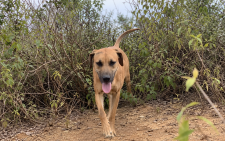

“The Director of Public Prosecutions Renson Ingonga, CBS, OGW has reaffirmed his office’s commitment to strengthening international cooperation in the fight against wildlife and environmental crimes following talks with a delegation from the United Nations Office on Drugs and Crime (UNODC), Regional Office for Eastern Africa,” the statement read in part.
Kenya expands wildlife enforcement measures
Kenya has continued to strengthen multi-agency efforts aimed at curbing wildlife crime and protecting critical ecosystems.
In May 2025, the Kenya Wildlife Service, working alongside the Kenya Police and African Wildlife Foundation, launched a canine handling course at the Kenya Police Dog Unit Training Academy in Lang’ata.
The programme trained 21 rangers, including seven women, to form specialised human-canine teams capable of detecting wildlife contraband at strategic entry points such as Jomo Kenyatta International Airport and Kilindini Harbour.
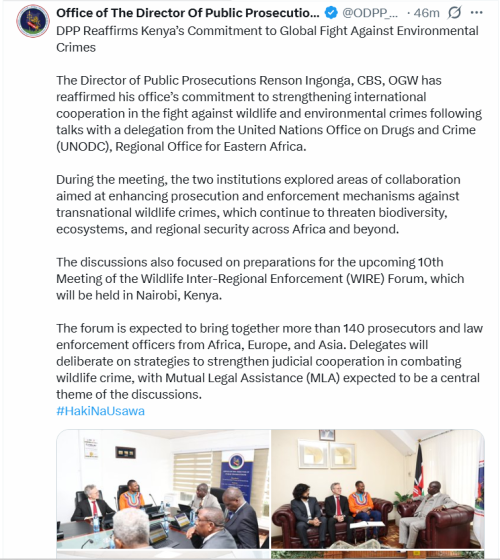
Authorities say the canine units have evolved significantly since their introduction in 2015, becoming a key part of Kenya’s wildlife protection and anti-smuggling operations.
In April 2026, KWS also launched the third phase of a wildlife translocation exercise involving nearly 200 herbivores, including Grant’s gazelles and elands, from the shrinking Kedong Ranch corridor near Lake Naivasha to safer conservation areas such as Solai Sanctuary.
The exercise followed earlier relocations of more than 450 animals as conservationists responded to increasing habitat fragmentation caused by land subdivision, fencing, road construction, and expanding human settlement.
Authorities raise alarm over ant trafficking
Authorities are also dealing with emerging forms of wildlife trafficking. During the rainy season, giant African harvester ant queens around Gilgil have become targets for international smugglers supplying exotic pet collectors in Europe and Asia.
Conservation officials say a single red queen can fetch up to Ksh28,000 on the black market, with smugglers transporting them in test tubes packed with moist cotton wool.
Recent enforcement operations led to the seizure of 5,000 queen ants in Naivasha and another 2,000 from a Chinese national at JKIA. Authorities have warned that the trade poses risks of biopiracy, ecosystem disruption, and the spread of invasive species abroad.
Kenya has also introduced measures to improve public engagement in conservation areas. In May 2025, KWS rolled out express entry lanes for prepaid ticket holders at Nairobi National Park following public complaints over congestion at the facility.
The engagement between the ODPP and UNODC highlights Kenya’s continued focus on combining enforcement, conservation management, and international cooperation as the country intensifies efforts to protect wildlife and biodiversity.
Author
Latest News






Advertisement
More on News