Advertisement
DIG Lagat unveils 5-pillar strategy to combat gender-based violence
Thursday 21st August, 2025 07:31 PM|

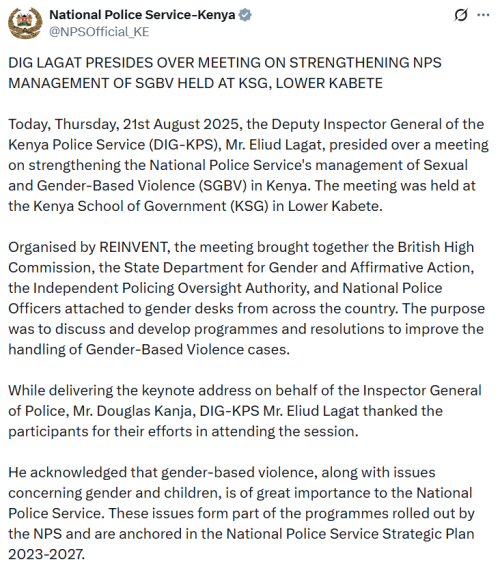
Deputy Inspector General of the Kenya Police Service (DIG-KPS) Eliud Lagat has unveiled a five-pillar plan aimed at reshaping how the National Police Service responds to Sexual and Gender-Based Violence (SGBV).
Speaking at the Kenya School of Government in Lower Kabete on August 21, 2025, during a high-level meeting convened by REINVENT in partnership with the British High Commission, the State Department for Gender and Affirmative Action, and the Independent Policing Oversight Authority, Lagat stressed the urgent need for reforms in the fight against GBV.
“Gender-based violence, along with issues concerning gender and children, is of great importance to the National Police Service,” Lagat said in a keynote address delivered on behalf of Inspector General Douglas Kanja.
Pillars for reform
Lagat’s strategy, part of the NPS Strategic Plan 2023–2027, sets out five areas of focus.
You Might Also Like



First is institutionalising a survivor-centred approach to justice, ensuring victims receive empathetic and timely support. Second is upgrading existing gender desks into a specialised elite investigations unit to improve case resolution.
Third, the DIG highlighted the role of technology in improving accountability, proposing digital tools to track and prosecute offenders. The fourth pillar involves rebranding the service into a multi-sectoral support system through collaboration with civil society and government agencies.
The final commitment is to foster a new era of accountability within the police and to the public.
“I envision a Kenya where everyone is free from the fear of gender-based violence,” Lagat told participants, pledging his personal assurance that the service would strengthen its response to children’s issues and survivor support.
Building on existing models
The five-pillar plan builds on ongoing initiatives, including the POLICARE model, a one-stop support centre launched in 2022 through collaboration with REINVENT and the British High Commission. The programme has eased survivors’ access to justice by offering integrated services under one roof.
Stakeholders welcomed Lagat’s proposals, noting the need for practical implementation. The forum emphasised that systemic reforms, if well executed, could restore public trust and improve conviction rates in GBV cases.
Rising Calls for Action
The announcement comes amid rising concern over GBV in Kenya. In May, Cabinet Secretary for Gender Hanna Cheptumo told the Senate that 97 women were killed in gender-related murders between August and October 2024, calling for urgent systemic change.
Taita Taveta Woman Representative Lydia Haika Mizighi, addressing a sensitisation event in July, warned against silence, saying, “It is time we act together to protect survivors and ensure perpetrators are brought to justice.”
Lagat’s roadmap, with implementation set for 2027, now places the police at the centre of efforts to end gender-based violence through accountability, technology, and survivor-focused reforms.
Author
Latest News








Advertisement
More on News