Advertisement
Muturi raises transparency concerns over IEBC’s 2027 election plan
Wednesday 24th June, 2026 02:29 PM|

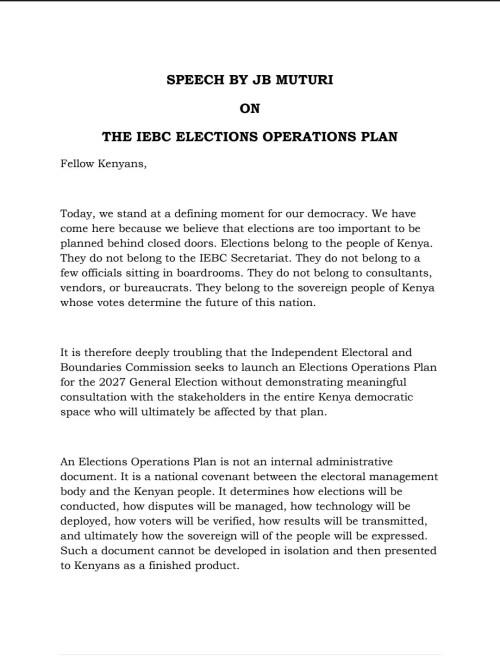
Former Public Service Cabinet Secretary Justin Muturi has questioned the Independent Electoral and Boundaries Commission’s (IEBC) decision to launch its 2027-2032 Strategic Plan and Elections Operations Plan, warning that the process risks undermining public confidence in the next general election due to what he described as inadequate stakeholder consultation.
In a statement issued on Wednesday, June 24, 2026, Muturi has argued that the electoral commission should not unveil key election planning documents without first engaging political parties, civil society organisations, religious groups, professional bodies and election experts.
According to Muturi, the Elections Operations Plan will shape critical aspects of the electoral process, including voter verification, technology deployment, dispute resolution and results transmission, making public participation indispensable.
“An Elections Operations Plan is not an internal administrative document. It is a national covenant between the electoral management body and the Kenyan people,” Muturi said.
You Might Also Like



Muturi has faulted the commission for what he termed an exclusionary approach to election planning, insisting that legitimacy can only be achieved through broad stakeholder engagement.
“Public confidence is not built through secrecy. Credibility is not achieved through exclusion. Trust is not earned by informing stakeholders after decisions have already been made,” he stated.
The former Attorney General has also rejected any justification that consultations may have been skipped because of budgetary limitations, arguing that the consequences of disputed elections far outweigh the costs of stakeholder engagement.
“The cost of consultation is insignificant compared to the cost of a disputed election. The cost of bringing stakeholders together is insignificant compared to the billions of shillings lost through election petitions, political instability, economic uncertainty and declining public confidence in democratic institutions,” he said.
Muturi further raised concerns about the integrity of the voter register, maintaining that any audit of the register should begin with an examination of the Integrated Population Registration Database (IPRD), which provides the source data for voter registration.
He argued that flaws in the population database would inevitably compromise the credibility of the voters’ roll.
“If irregular records exist in the Integrated Population Registration Database, those same irregularities will eventually contaminate the voter register. A credible voter register can only emerge from a credible population database,” he added.
The former Cabinet Secretary also called for transparency in any audit process, saying it should be open to observation by political parties, civil society organisations, religious groups, professional bodies and citizens.
“The audit process itself must be transparent. It must be open to accredited observers,” Muturi further noted.
Muturi concluded by urging the IEBC to suspend the launch of the Strategic Plan and Elections Operations Plan and instead embark on a comprehensive consultation process involving all stakeholders in Kenya’s democratic space.
“The IEBC must understand that legitimacy comes from participation. It comes from consultation. It comes from ensuring that every stakeholder feels that they have been heard and respected in the planning process,” he said.
IEBC strategic and election operations plans
The sentiments from the former National Assembly speaker have come hours after the Independent Electoral and Boundaries Commission (IEBC) launched its Strategic Plan 2024–2029 and the Election Operations Plan 2025–2027, setting out its roadmap for strengthening electoral management and preparing for the 2027 elections.
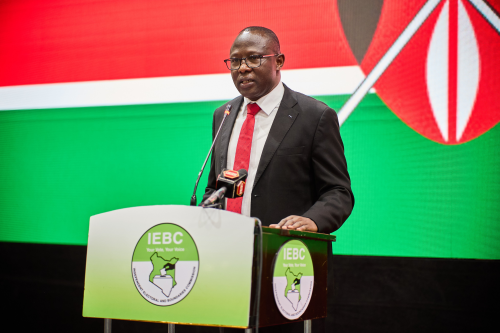
Speaking during the launch on Wednesday, June 24, 2026, IEBC Commissioner Francis Aduol explained that while the strategic plan covers the period beginning in 2024, its unveiling was delayed to allow the current commissioners to review and contribute to the document after assuming office.
“You will notice we are presenting this in 2026, yet the strategic plan itself is for 2024–2029. Strictly speaking, we should have presented this before 2024 started,” Aduol said.
Author
Latest News







Advertisement
More on Inside Politics