Centum CEO James Mworia named among 6 appointed to Kenya’s National Infrastructure Fund board
By Kenneth Mwenda, July 9, 2026Treasury Cabinet Secretary John Mbadi has appointed Centum Investment Company Chief Executive Officer (CEO) James Mworia Mwirigi and five others to the board of the National Infrastructure Fund (NIF), marking a major step in operationalising the new infrastructure financing vehicle.
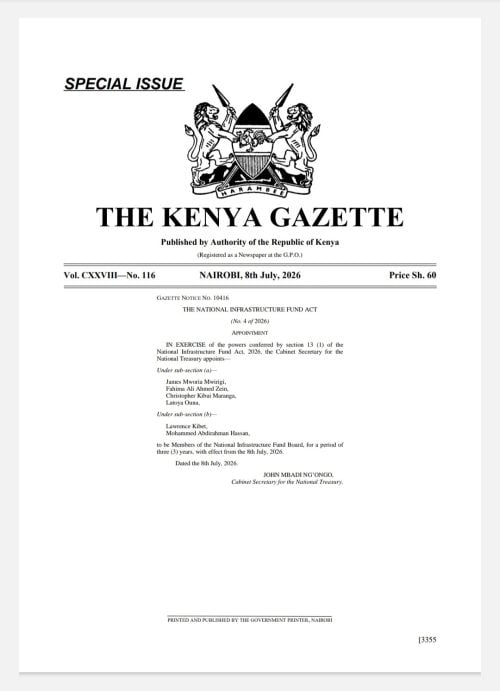
The appointments were made through a special Kenya Gazette notice dated July 8, 2026, under Section 13 (1) of the National Infrastructure Fund Act, 2026. The six members will serve a three-year term starting immediately.
“IN EXERCISE of the powers conferred by section 13 (1) of the National Infrastructure Fund Act, 2026, the Cabinet Secretary for the National Treasury appoints—Under sub-section (a)—James Mworia Mwirigi, Fahima Ali Ahmed Zein, Christopher Kibui Maranga, Latoya Ouna, Under sub-section (b)—Lawrence Kibet, Mohammed Abdirahman Hassan,” The Gazette notice stated.
“To be Members of the National Infrastructure Fund Board, for a period of three (3) years, with effect from the 8th July, 2026.”
Mworia, who leads Centum Investment Company as CEO, brings experience in business leadership, investment management, law and accounting. His appointment places a private sector investment executive at the centre of a fund designed to attract long-term capital for Kenya’s major infrastructure projects.
Lawrence Kibet, another key appointee, currently serves as Director General for Public Investments and Portfolio Management at the National Treasury. Christopher Kibui Maranga, also known as Chris Maranga, previously served as Regional Director for East Africa at Acumen.
The National Infrastructure Fund was created to provide an alternative way of financing large projects by reducing reliance on government borrowing. The fund will mobilise money from government allocations, private investors, privatisation proceeds, grants, loans and investment returns.
President William Ruto signed the National Infrastructure Fund Act into law in March 2026, establishing the framework for the fund.
The government has already identified the NIF as a major vehicle for financing projects in roads, airports, energy, ports, water infrastructure and other strategic sectors.
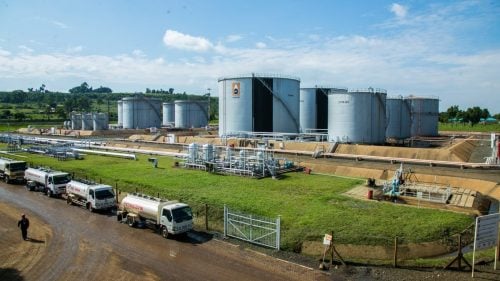
The fund received its first major capital injection after the government channelled Ksh103.45 billion from the sale of a 65 per cent stake in Kenya Pipeline Company into the vehicle.
Treasury also expects additional capital from the partial sale of the government’s stake in Safaricom, with proceeds expected to support infrastructure investments.
NIF moves into action
One of the major projects linked to the fund is the planned modernisation of Jomo Kenyatta International Airport, which is expected to expand passenger and cargo capacity. The government has also identified highway expansion projects, including the Nairobi-Namanga road, as potential beneficiaries.
The NIF board will provide strategic oversight, approve investment direction and monitor how projects financed through the fund perform.
President Ruto has described the new financing model as a shift from dependence on debt towards investment-led development.
Speaking during the signing of the Sovereign Wealth Fund Bill on July 8, the President said:
“Today, Kenya changes how it will preserve its wealth. Today, we enshrine in law the institution that will ensure that the prosperity those assets create endures for generations.”
The National Treasury has also moved to address concerns surrounding the fund after false claims circulated online that the government planned to use SACCO savings to finance infrastructure projects.
The Treasury dismissed the claims as fake, saying the National Infrastructure Fund would not access SACCO deposits or ordinary Kenyans’ savings.
“The government of Kenya has no access to the funds, neither does it intend to utilise these funds,” State Department for Cooperatives Principal Secretary Patrick Kilemi said while clarifying the issue.
The appointment of the board gives the National Infrastructure Fund the leadership structure required to begin full operations. With members drawn from government, investment and business backgrounds, the fund is expected to play a central role in Kenya’s plan to finance infrastructure through partnerships with private investors.