Advertisement
Atheists Kenya condemns Rhema Feast, urges Kenyans to avoid such events
Saturday 06th September, 2025 08:53 AM|

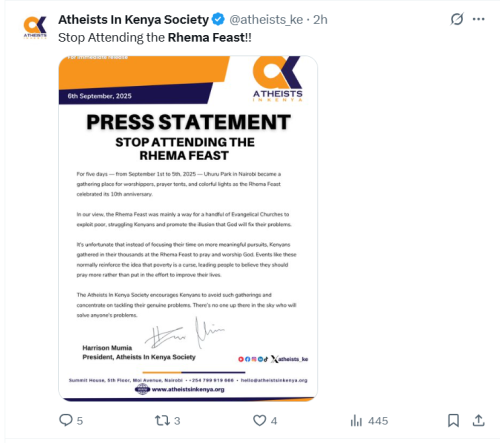
Just hours after the close of the colourful Rhema Feast 2025, the Atheists in Kenya Society (AIK) has stirred fresh controversy with a hard-hitting statement urging Kenyans to shun such gatherings and instead concentrate on tackling pressing national issues.
The five-day gospel festival, organised by Ruach Assemblies under Reverend Julian Kyula, drew tens of thousands to Uhuru Park from September 1 to 5.
“STOP ATTENDING THE RHEMA FEAST. Events like these normally reinforce the idea that poverty is a curse, leading people to believe they should pray more rather than put in the effort to improve their lives.
“The Atheists in Kenya Society encourages Kenyans to avoid such gatherings and concentrate on tackling their genuine problems,” read the press statement by Atheists Kenya on X dated September 6, 2025.
You Might Also Like

It marked its 10th anniversary with a blend of sermons, music, and testimonies that turned the venue into a spiritual epicentre. The climax on Friday featured Nigerian gospel stars Apostle Joshua Selman and Nathaniel Bassey, whose trumpet-led worship sessions electrified the crowd.
Spiritual renewal
The feast attracted praise from religious and political leaders alike. Music Copyright Society of Kenya CEO Ezekiel Mutua lauded the event as “epic,” pointing to the mammoth crowds, pomp, quality of speakers, and seamless organisation. Nairobi Woman Representative Esther Passaris shared her excitement on social media, describing it as a powerful moment of faith and unity in prayer.
Mumias East MP Peter Salasya, known for his vibrant public persona, went as far as to call his attendance a “Damascus moment,” hinting at a personal spiritual shift. For many of the faithful, testimonies of healing and renewal capped off what was seen as a milestone in Kenya’s evangelical calendar.
Atheists push back
But the Atheists in Kenya Society offered a sharp counter-narrative. In the statement, AIK president Harrison Mumia accused organisers of exploiting vulnerable Kenyans.
“In our view, the Rhema Feast was mainly a way for a handful of evangelical churches to exploit poor, struggling Kenyans and promote the illusion that God will fix their problems,” the statement read.
The group lamented what it termed misplaced priorities, saying Kenyans should channel their energy towards solving real-life challenges rather than “reinforcing the idea that poverty is a curse that prayer alone can cure.”
It further argued that such gatherings entrench dependency on divine intervention instead of encouraging practical solutions.
“The Atheists in Kenya Society encourages Kenyans to avoid such gatherings and concentrate on tackling their genuine problems. There’s no one up there in the sky who will solve anyone’s problems,” the statement concluded.
The strongly worded remarks have reignited debate on the role of religion in Kenya’s public life, exposing the stark divide between the country’s deeply rooted faith traditions and those calling for a more pragmatic, secular approach to national progress.
Author
Latest News







Advertisement
More on News