Advertisement
Assemblers gain as imports of fully-built motorcycles drop
Wednesday 05th February, 2020 12:00 AM|
John Otini
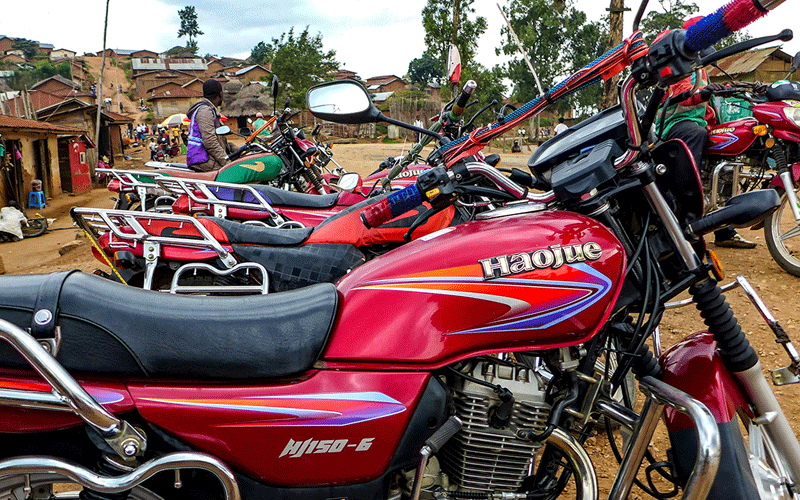
Changing local dynamics saw motorcycle manufacturers get a boost last year after imports of fully-built units dropped for the first time in five years by 50 per cent to lift revenues and local job opportunities.
Data from State firm Kenya Trade Network Agency shows that purchases of imported motorcycles dropped in a drastic turn of events from Sh314.2 million in 2018 to Sh117.4 million in 2019 after rising year-on-year since 2014.
On the other hand, numbers from the Kenya National Bureau of Statistics show that new motorcycle registrations in the country increased by 20,000 units to stand at 174,645 in the nine months to September 2019.
The key winners in the industry include Indian automaker Bajaj which controls 39 per cent market share and Car&General that controls 21 per cent of the market.
Others include Honda, Hero, Haojin, Skygo, Captain, Dayrun according to National Treasury. There are also several makeshift assemblers across the country.
“The reduction in imports of motorcycles could have been caused by an increase in local production capacity reducing demand for foreign units,” said Economist Patrick Shaw.
The local assembly plants were operating at 50 per cent of their capacity as of 2019, according to the Draft National Automotive Policy of 2019 during which time analysts said there has been an over saturation of motorbikes as it becomes a favourite ride countrywide.
“We are working on a policy which is with the Treasury to help address concerns faced by assemblers such as tax because the capacity is huge, people have invested a lot,” said Lyn Karigu of the Motorcycle Assemblers Association of Kenya (MAAK).
Karigu says they pay 10 per cent duty on imports of parts as opposed to the 25 per cent duty levied on fully-built units that are imported.
Nearly all motorcycles in Kenya are produced from complete knock-down kits(CKD) parts.
A few participants about 5 percent produce motorcycles from semi-knockdown kits (SKDs). Motorcycle purchases have been boosted by increased availability of credit from banks such as KCB and NCBA and other enablers.
Industry lobby MAAK estimates that in a day, the boda bodas can do 22 million rides a day with each rider making up to Sh1,500.
Boda boda Association of Kenya national chair Kevin Mubadi says: “There has been a lot of incentives in the market in areas of tax and financing helping to drive uptake.”
Overall demand
Economists say boda boda have become the main mode of transport and the market is endless. “If the assemblers get price and quality right, overall demand will remain strong going into the future,” says Shaw.
He adds that the challenge is that local assembly firms sometimes struggle to compete with imports.
“For instance, Japanese motorcycles are stronger than Chinese ones, you need to ensure that the quality is good if you assemble here.”
The expansion of the motorcycle sales has also boosted parts business even as repair jobs grow country-wide.
Mubadi adds that the industry, which is struggling with the tag of aiding crime and traffic infractions, has tabled draft regulations and handed it to the government.
“We expect Cabinet Secretary Fred Matiang’i to release the recommendations or amend them to bring sanity in the sector,” he says referring to the report by the 12-member taskforce commissioned to enhance safety in the industry.
President Uhuru Kenyatta last year issued a directive instructing government agencies to only purchase locally assembled vehicles in a change of heart that assemblers hope would help them bargain in their favour.
The annual market for motorcycles is nearly 200,000 units. Motorcycle Assemblers, when combined, have an investment of over Sh1 billion.
It is estimated that there are 700,000 boda boda riders out there earning an average of Sh1,000 a day. This translates to about Sh700 million a day in revenues countrywide.
Author
People Reporter
View all posts by People ReporterLatest News






Advertisement
More on News