Advertisement
The little explored county of Marsabit
Thursday 28th November, 2019 12:00 AM|
For a long time I had heard of people heading to northern Kenya for travel adventures, but I had never envisioned going as far as Marsabit.
Well, not until I heard that there was someone taking people for a desert safari in the county, a growing trend amongst the more adventurous Kenyans.
Unfortunately, it had rained heavily in Nairobi on the morning of the trip that I was tempted to cancel and just spend indoors.
But since I had committed to travel, I set off at dusk for the eight-hour journey. Situated in northern Kenya, Marsabit borders Wajir to the Northeast and Lake Turkana to the West, sharing its southern boundary with Samburu and Isiolo counties. To the north is Ethiopia.
The destination is located 532km from Nairobi via a tarmacked road where one can enjoy beautiful sites along the way such as snowcapped Mt Kenya, Mt Ololokwe and the numerous, majestic ranges of the north.
Packed in our tour trucks were tents, mattresses as well as the food and utensils for use during our two-day stay. We arrived at around 4pm and were scheduled to have a game drive inside the Marsabit National Park.
The small park is situated on the slopes of Mount Marsabit and though we didn’t see any animal, it’s said to have buffaloes, leopards as well as elephants, with some of the jumbos said to be have huge tusks.
The late Ahmed the elephant who made this area his habitat was one of the huge tuskers residing in the park.
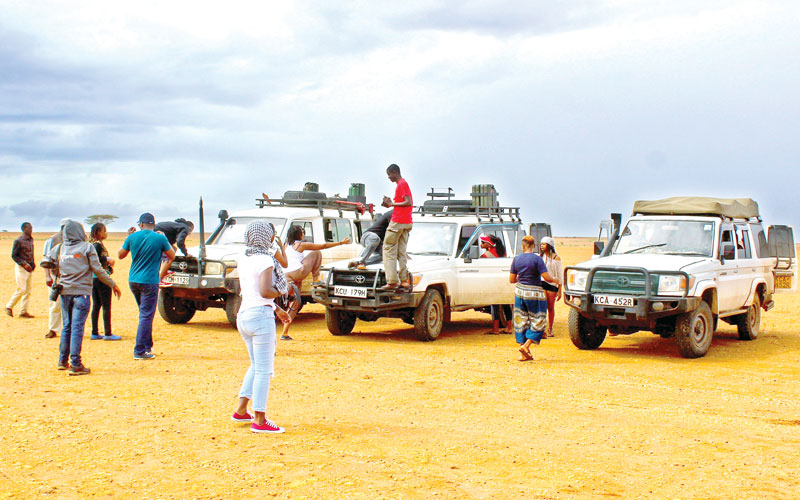
Photo/PD/HARRIET JAMES
Annoyingly, a Toyota Land cruiser van we expected to take us there was late. Still, we managed to enter the park on time and do a one-hour game drive.
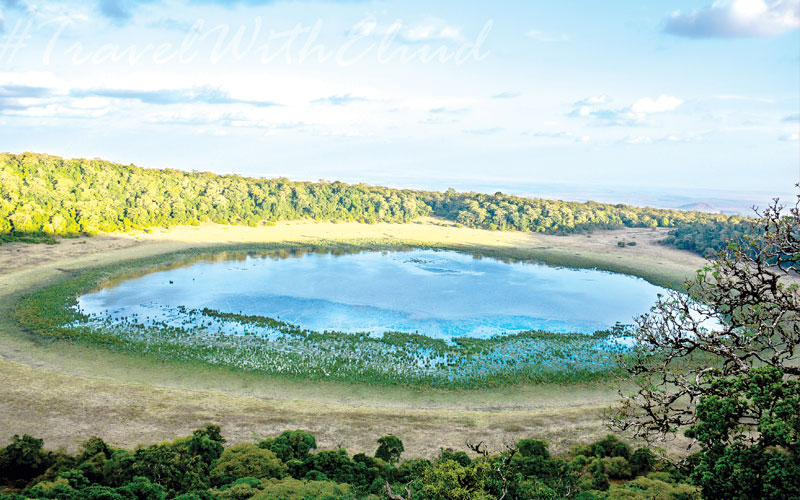
Our driver lost the way and we couldn’t reach a crater lake named Paradise. However, we held a nice sundowner in the park and took many photos of the beautiful scenery.
Rendille morans
Being curious, I spent some time with friendly Rendille young men taking care of livestock in the park. Afterwards, we headed to the Marsabit Kenya Wildlife Service camp for the night.
There are other accommodation options available in Marsabit, but we had opted for a camping experience. This was my third camping adventure and I have by now gotten used to pitching a tent and to be ready for cold nights.
The only nightmare was having to take a cold shower late at night, with the howls of hyenas and mooing of buffaloes acting as background music. We went to shower in twos, guarded by an armed KWS ranger.
Stalked by hyenas
Afterwards, we would spend the night sharing our showering and later our life experiences. Somebody (as usual Kenyan style) ignored the warden’s warning not to carry food to the tents and paid for it with a sleepless night; the whole night, hyenas kept roaming around his tent!
In the morning, we end up laughing at the incident, jokingly calling him team mafisi. A heavy downpour did not stop us from boarding our tour vans and travelling 94km further up to North Horr for a desert experience.
“For so long, Marsabit has been known for conflict and insecurity, but I want people to come here for adventure.
To know that there’s so much more to this place than just the stories of bandit attacks,” explained tour operator Eliud Ndung’u, CEO of Safiri Nasi, as we drove along the muddy paths.
He said he got bored of always taking people to the Coast and the Masai Mara, so one day he took a step of faith and chart a new path in the north, especially Chalbi Desert tours.
As we drive along, we saw white Toyota Land Cruisers speeding along the muddy paths, more or less like matatus.
We passed women carrying heavy loads of firewood on their backs, past Rendille men grazing their livestock on the green pastures brought about by recent rains.
“Regardless of whether a Rendille man is educated or not, they must build a manyatta house,” said our driver Mohammed Huka, pointing at the mud structures huddled together in small villages.
He was born and raised in Marsabit, renowned for its 20 beautiful hills. I wondered how unbearable life could have been if I was born and raised in this region in the middle of nowhere.
As I watched the residents, I realised that surprisingly life here is vibrant, people still multiply, eat, sleep and die like all of us.
Our van got stuck just as we were about to enter the desert, which became an opportune moment for us to relieve ourselves in the bus (where else?) and take photos. We were lucky to have an older driver, who assisted us drive the vehicle out of a ditch.
The van traversed the desert road till we reached a windy village in North Horr. We were all ecstatic as we changed into hats, sunglasses, sandals and comfortable clothing for the desert experience — and selfie moments. The view was spectacular, the sand dunes numerous.
It seemed like we were in another part of the world and not in Kenya. We relaxed for about an hour before traversing the same route back to our camps.
Author
Latest News






Advertisement
More on Lifestyle