Advertisement
Ten actions to protect global economy from Corona
Tuesday 24th March, 2020 12:00 AM|
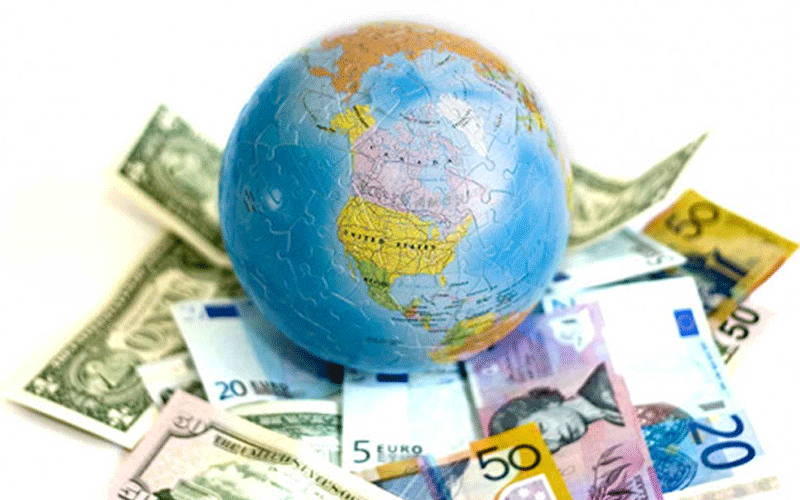
The coronavirus pandemic has challenged the human capital of the world and in equal measure if not more, is the pressure that governments are feeling over their economic capital. The full scale economic impact of the outbreak is still unknown but boosters are already being announced. Here are 10 ways countries are sanitising their economies to cope with the pandemic.
Low interest rate
The US Federal Reserve has cut interest rate to zero, and announced a mega $700 billion (Sh70 trillion) quantitative easing programme as the economy reels under the coronavirus pressure.
The Fed also said it will begin buying bonds, a move that will pump money directly into the economy.
Replanning
You Might Also Like


Britain launched a £30 billion (Sh3.9 trillion) economic stimulus plan just hours after the Bank of England slashed interest rates, a double-barreled package aimed at warding off the risk of a coronavirus recession.
The UK has also slashed interest rates on loans for small and medium businesses.
Stronger infrastructure
Italy announced a $28 billion (Sh2.8 trillion) dollar package to strengthen its health infrastructure.
The government said payments on mortgages will be suspended across the whole of Italy and Italy’s banking lobby ABI said lenders will offer debt moratoriums to small firms and households grappling with the economic fallout from the virus.
Fresh cash liquidity
The Reserve Bank of India plans to infuse fresh cash liquidity into the system through a second round of long-term operations.
The government is, meanwhile, pushing State-run banks to approve new loans amounting to ₹500 billion to ₹600 billion (Sh695.8 billion to Sh835.5 billion) by the end of March.
Increase lending
The Bank of Japan said it will double its purchases of risky exchange trade funds to a pace of around 12 trillion Yen ($11.3 trillion) a year and it will also create a new loan programme to extend one-year, zero-rated loans to financial institutions to boost lending to firms hit by the outbreak.
6. Longer loan terms
Apart from the Sh500 million rescue packages for the tourism and hospitality industry set aside by the Ministry of Tourism and Wildlife, the Kenyan government has extended loan repayments by one year with banks and telcos slashing some money transfer fees including scrapping of transaction charges for transfers between mobile wallets and bank accounts.
High public investment
Germany’s centre-left coalition has agreed to increase public investments by €12.4 billion (Sh1.4 trillion) by 2024 and to make it easier for companies to claim subsidies to support workers on reduced working hours to counter the effects of the coronavirus pandemic.
It will also boost investments by €3.1 billion (Sh352.6 billion) per year between 2021 and 2024.
Cushion economy
The government announced a stimulus package of 11.7 trillion won (Sh980 billion) to cushion the economy against the impact of coronavirus.
Starting March 11, stocks with a sudden and abnormal increase in short-selling transactions will be suspended from further short-selling for 10 days.
Review work schemes
The government is allowing companies to suspend payments of some social charges and taxes, and is activating state-subsidised short-time work schemes.
It has also ordered the Bpifrance State Investment Bank to guarantee loans needed to overcome short-term cashflow problems.
Cheaper loans
The People’s Bank of China (PBOC) has injected 100 billion Yuan ($1.4 trillion) into the financial system by offering cheap loans to banks.
PBOC has also announced it would cut the amount of cash banks must hold as reserves in a move that will pump 550 billion Yuan ($7.9 trillion) into the banking system.
Author
People Daily
View all posts by People DailyLatest News








Advertisement
More on Lifestyle