Advertisement
Will Kenyans trust the protest victims’ compensation panel?
Thursday 04th September, 2025 08:50 PM|

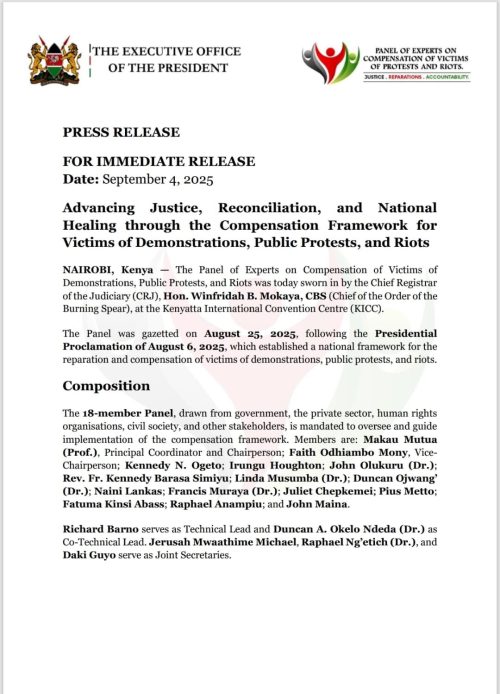
On Thursday, September 4, 2025, a new chapter opened in Kenya’s long and painful history of protest-related violence.
At the Kenyatta International Convention Centre (KICC), the government officially launched the Panel of Experts on Compensation of Victims of Protests and Riots, an 18-member team sworn in by Chief Registrar of the Judiciary, Winfridah Mokaya.
Chaired by Prof. Makau Mutua and deputised by Faith Odhiambo, the panel has been tasked with an ambitious mission: to design and operationalise a framework that verifies, categorises, and compensates victims of demonstrations and riots dating back to 2017.
Gazetted on August 25, 2025, following President William Ruto’s proclamation, the initiative has been sold as a path to justice, reparations, and national healing.
You Might Also Like


But as history reminds us, Kenyans have heard such promises before. The lingering question is not whether the panel has a noble mandate, but whether the public will trust this framework to deliver real justice.
Lofty promises
In his remarks, Mutua called the initiative “a historic, unprecedented, and bold step to lead in the healing of our country,” pledging to execute the mandate with “honour, rigour, and integrity.” Vice-Chair Faith Odhiambo described the panel’s work as “unprecedented but overdue” and one that could transform Kenya’s reparations framework.
Yet, scepticism is deeply rooted. Families of victims at the inaugural meeting demanded transparency and psychosocial support—an early sign of doubt in the government’s sincerity. This mistrust is not unfounded. Amnesty International has recorded grim figures: 50 killed in the 2017 election protests, 31 during the 2023 Azimio demonstrations, 63 during the 2024 Gen Z protests, and at least 38 deaths with 130 injuries in 2025 alone, according to KNCHR.
These are not just numbers—they are lives lost, families shattered, and communities traumatised. For many Kenyans, financial compensation without accountability for those who ordered or executed the violence feels hollow.
Former Nairobi Town Clerk Philip Kisia captured this sentiment, declaring, “You can’t compensate for murder, but the first thing before we go through the framework is a genuine public apology.” He argued that an apology from President Ruto—particularly to grieving mothers—would carry more weight than any payout.
Justice?
Civil society has been even more direct. Lawyer Gitobu Imanyara dismissed the framework as a “diversion from more pressing international scrutiny,” pointing to U.S. Congressional enquiries into the 2024 Gen Z killings. Activist Fredrick Ojiro of Vocal Africa insisted, “You cannot compensate when you do not accept the guilt. President Ruto must first acknowledge that their rights were violated.”
Suba Churchill of the Kenya National Civil Society Centre added, “We have yet to see a clear acknowledgement of the responsibility the government holds for the violent actions against peaceful Kenyans.”
Social media reactions mirrored this mood. Replies to Prof. Mutua’s announcement on X included accusations of “blood money” and “PR gymnastics”. User @jrchebonn bluntly wrote, “Justice before compensation.”
Such scepticism has roots in past failures. Survivors of the 2007–2008 post-election violence only received partial payments of Ksh16 million in 2025—13 years after the atrocities. Even court-ordered awards, such as the Ksh100,000 granted to 206 victims in 2022, have stalled due to delays in Parliament. With this history, why should Kenyans believe the new panel will act swiftly and transparently?
Beyond money
The economic context only heightens the unease. The World Bank reported in 2023 that 60% of government revenue goes to debt servicing, leaving little room for reparations. Many fear that compensation could be used as a smokescreen to deflect from systemic failures and ongoing human rights violations.
The panel has just 120 days—until December 6, 2025—to complete its mandate. Treasury CS John Mbadi has promised quick disbursements, but efficiency without accountability could undermine rather than build trust.
As Francis Mwangangi, Deputy Governor of Machakos, put it, “The process must be transparent, inclusive, and address recurring issues of human rights, social justice, rule of law, and democracy.”
This is the real test: not the size of the cheques, but whether Kenya will finally confront the truth of state violence, issue genuine apologies, and prosecute those responsible. Without these steps, compensation risks are viewed as an empty gesture—a financial bandage over unhealed wounds.
Path forward
To their credit, Mutua and Faith Odhiambo bring human rights credentials, and their leadership could help navigate the political sensitivities of the moment. But as critics point out, their government ties may also erode confidence. True justice requires independence, honesty, and courage—qualities Kenyans will be watching for closely.
For now, the launch of the compensation panel offers a fragile glimmer of hope. But hope alone is not enough. As Kenya marks 15 years since the 2010 Constitution, the victims of police bullets and tear gas deserve more than promises. They deserve truth, accountability, and dignity.
The panel has been given the chance to turn words into action because for the mothers who buried their children after peaceful protests, no cheque will ever be enough—only justice will.
Author
Latest News




Advertisement
More on Insights