Advertisement
Untold suffering of Lake Bogoria climate refugees
Tuesday 04th July, 2023 05:15 AM|
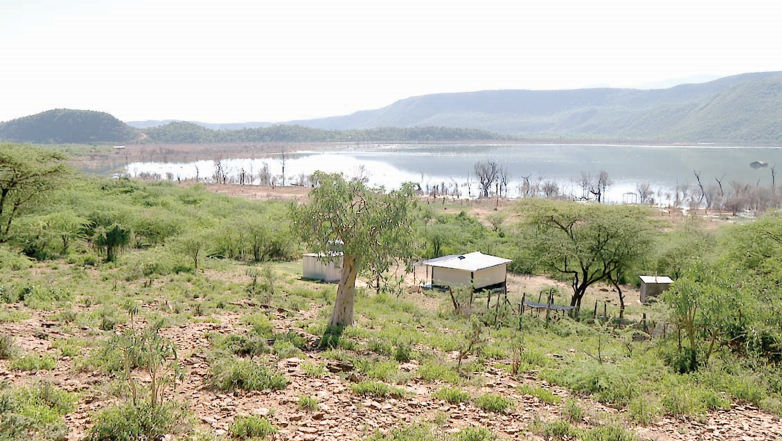
Hundreds of women and children displaced by the rising lake waters in Rift Valley continue to bear the brunt of the devastation three years after they were displaced from their homes by swelling lakes.
In 2019, residents of Baringo County living near Lake Bogoria were displaced after water from the lake flooded the area, a phenomenon scientists attributed to climate change, siltation, poor land use and tectonic plate movements underground.
As we drove past Lake Bogoria recently, we noticed several sparsely distributed makeshift houses tucked in the thickets. One would only wonder how it is like living in isolation, prone to wildlife attacks and insecurity.
At Kapasungu village, we meet Beatrice Kurgat, going about with her house chores as the scorching sun of Baringo unapologetically blazes the sparse vegetation. Upon seeing us, she quickly drops her work and welcomes us with a bright smile. We exchange pleasantries as she narrates her story.
Lost land and crops
“I have lived here all my life and only a few years back did things start changing. I lost two acres of my land. One acre sat my homestead while the other one I used to farm various crops. I used to plant vegetables, maize and fruits, enough for my family,” says Kurgat.
Her family is among 50 climate refugees living in the Lake Bogoria National Reserve. She says the burden of taking care of her family became heavier after she was displaced and her 15-year-old daughter got pregnant giving birth to twins. “It has been extremely tough on me since I am the sole breadwinner of my family. My grandchildren need milk and a special diet and the demand to feed my family has seen my daughter leave the children in my care on certain days to engage in manual jobs for some income,” she adds.
Inaccessible medical facility
One of the twins was unwell, and they had no spare money for transport to take the toddler to hospital. At the end of our interview, we offered to take them to the nearby Loboi dispensary, which is several kilometres from the game reserve.
Loboi area, where the dispensary is located, was hit hard by Lake Bogoria’s rising waters and as the only medical facility in the area with a maternity wing, it was completely submerged.
Gilbert Kosgei, the nurse in charge of Loboi dispensary, tells us women in the locality have been undergoing untold suffering seeing as they are not able to get maternity services easily. Some have resorted to giving birth at home while others must travel tens of kilometres to get maternity services. This, she adds, has put the lives of these women and their unborn babies at risk. “Expectant women have no health care facility fromwhere they can deliver their babies from. What is left here is a dilapidated facility that cannot meet the needs of these women. Now they are forced to travel all the way to Marigat town, more than 20 kilometres away to access this servcie,” discloses Kosgei.
He further adds that cases of upper respiratory ailments, malaria and typhoid occasioned by environment contamination have been on the increase.
We left Kurgat’s daughter and her grand-children being attended to as we proceeded to other homesteads in the game reserve.
Solomon Chepsoi lives a few kilometres from the dispensary. He narrates how the community was left with nowhere to go after the waters slowly started displacing them. “As the waters slowly swallowed our land, we had to move, leaving behind 15 acres of land where I used to do subsistence and commercial farming,” says Chepsoi adding that his source of income had been cut off, savings drained and his son dropped out of school. “I lost all that I had. I sold my goats and cows, now I live with wildlife. Here, we live among hyenas and leopards and even keeping livestock is impossible, further straining our efforts to be self-sufficient,” he says.
The national reserve is temporarily sheltering the displaced residents restricting them from putting up permanent houses and engaging in economic activities, such as farming. They, therefore, have to find other sources of income to fend for their families.
Long search for water
Chepsoi’s wife, Belinda, arrives from the river, which is five kilometers away, an activity she does every day to fetch water for domestic use. As she puts her jerrycan down, she is quick to mention how strenuous the activity is, yet the water is neither fit for drinking nor cooking for her family.
“The journey to the river is a matter of life and death. The danger of being attacked by poisonous snakes is nerve-chilling, but we have to take the risk to get water for our households,” she says.
Amid the natural calamity, the community is determined to overcome the challenges and adapt to the changing global phenomenon.
Belinda and 20 other women from Lake Bogoria Sossiche Women Group eked a living from selling curios and soft drinks to visitors entering the game reserve. Today, she is among Internally Displaced Persons (IDP’s) living in the game reserve.
“We had nine stores where we used to sell our merchandise from. It was a double tragedy for us in 2020, when floods and Covid-19 swept our businesses,” she says.
Judy Kiprotich who is also a member of the women’s group is washing clothes at the banks of the lake using water from a nearby spring. Due to the alkalinity of the water, it can only be used for washing.
The water is not suitable for drinking or cooking, even though it appears clean. The IDP’s are forced to buy clean drinking water from water vendors at Loboi shopping centre, several kilometres from their new homes. “When we work in peoples’ farms, we are paid Sh300, with that amount and the high cost of living, we only use it on food, and the money is not enough to buy drinking water. Our children are forced to drink this water just as it is,” she says.
The displacement and the harsh economic realities have made the community vulnerable to other social vices, such as teenage pregnancy. All the women we spoke to at the game reserve confirmed that there has been an increase in under age pregnancies in the area.
On the way, we meet Roseline Nyato, who also is a squatter at the game reserve, together with her Class Eight daughter from Loboi Primary School, who has been sent home for school fees.
Nyato is in search for casual labour in far away farms where she expects to earn between Sh250 and Sh300 for a whole day’s job.
But before going to the farms, she visits the school to plead with the teacher to allow her daughter to continue with studies, and allow her time to get the Sh1,700 school fees arrears.
James Lusute, a teacher at the Loboi Primary School says that children who come from the game reserve have been having a challenge of getting to school on time, due to fear of attacks from wildlife.
“Our children have been coming to school very late and leave early, but we are now working in collaboration with Kenya Wildlife Service and a private security farm who are doing patrols to make sure that pupils are safe. Things are getting better now,” he says.
Lake Bogoria National Reserve warden James Kimaru says that the national government through Baringo County Government integrated programme running for five years is undertaking interventions, such as public participation to deal with humanitarian crisis brought about by floods in the county. “To make sure that in future floods do not affect people living near the lake, Water Resources Authority has marked the highest point of the lake, to ensure that no infrastructure is undertaken past the marked points,” says Mr Kimaru.
Lake Bogoria is a breeding ground for lesser flamingoes, but after the floods, their numbers declined drastically.
A report by Kenyan government and the United Nations Development Programme (UNDP) last year showed that rising water levels had generated a humanitarian crisis, with about 75,987 and 379,935 people requiring urgent assistance households in 13 affected counties after they were displaced from their homes.
Author
Dan Kaburu
View all posts by Dan KaburuLatest News






Advertisement
More on Insights