Starmer resignation: What happens to Ksh427B strategic deals signed between Kenya and UK?
By Mustafa Juma, June 22, 2026The sudden resignation of UK Prime Minister Keir Starmer, barely two years after his historic 2024 election victory, has raised a quieter, more consequential question in Nairobi: what happens to the estimated Ksh427 billion (around £2.5–3 billion) in strategic agreements signed between Kenya and the United Kingdom under his leadership?
While leadership change in Westminster is not unusual, the timing of Starmer’s exit introduces uncertainty into a relationship that had been repositioned as one of Africa’s most forward-leaning UK partnerships in trade, climate finance, security cooperation, and digital economy investment.
Starmer’s resignation follows months of internal Labour Party pressure, cabinet resignations, and declining public approval amid economic strain and political fragmentation in the UK.
Despite early expectations that he would stabilise UK governance after years of turbulence, his administration became increasingly defined by policy reversals, leadership disputes, and mounting pressure from within his party.
Yet in foreign policy terms, his government had begun to carve out a distinct legacy, particularly in Africa.
One of the most significant pillars of that approach was the strengthening of UK–Kenya relations, culminating in a series of strategic agreements valued collectively at roughly Ksh427 billion across infrastructure financing, climate-related investments, trade facilitation, and security cooperation frameworks.
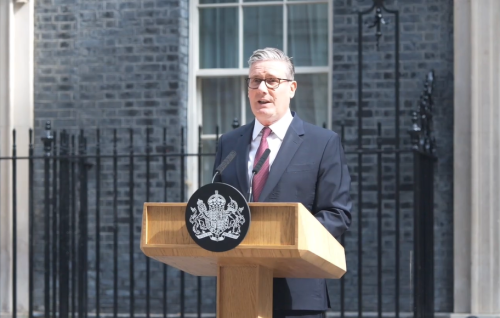
These deals were not symbolic. They were structured as multi-year commitments tied to UK development finance institutions, private sector partnerships, and bilateral government-to-government frameworks.
What exactly is at stake in the Kenya–UK deals?
While details vary across agreements, the strategic package broadly includes infrastructure and urban development financing, climate adaptation and green energy investment commitments, trade facilitation under the post-Brexit UK-Africa strategy, security and counter-terrorism cooperation, digital economy and innovation partnerships, and labour mobility and skills exchange programmes.
These initiatives were designed to outlive political cycles, on paper. But in practice, large bilateral agreements often depend on political will at the top of government, especially in systems where ministerial reshuffles or leadership changes can redirect priorities.
Does Starmer’s resignation cancel the deals?
A change of prime minister does not automatically cancel signed international agreements.
In the UK system, treaties and bilateral frameworks are generally executed by the state, not the individual leader binding unless formally renegotiated or withdrawn, and implemented through ministries, agencies, and parliamentary oversight.
So the Ksh 427 billion Kenya–UK package does not disappear with Starmer’s exit.
However, what can change is the following:
1. Political prioritisation
A new prime minister may shift focus toward domestic issues or different foreign policy regions.
2. Budget allocations
Even if commitments remain, funding timelines can be slowed, restructured, or reclassified.
3. Strategic direction
UK Africa policy has historically oscillated between expansion and retrenchment depending on leadership philosophy.
4. Implementation speed
Bureaucratic momentum often slows during leadership transitions, especially in large economic packages.
The Burnham factor
With former Greater Manchester mayor Andy Burnham emerging as the frontrunner to replace Starmer, early signals suggest continuity rather than rupture.
Burnham has previously advocated for stronger industrial policy, pragmatic international partnerships, and sustained engagement with developing economies.
That would suggest the Kenya–UK framework is unlikely to be abandoned outright.
Kenya’s position
For Kenya, the immediate risk is not the collapse of funding but the delay and renegotiation risk.
Nairobi has increasingly positioned itself as a regional financial hub, a green energy investment destination, and a strategic security partner in East Africa.
The UK partnership fits into this broader ambition. However, Kenya’s exposure lies in execution speed. Infrastructure and climate financing projects are particularly vulnerable to delays in approvals, disbursement schedules, and procurement processes tied to UK institutions.
The Ksh427 billion Kenya–UK strategic package is not in immediate danger of collapse. It is structured, institutional, and embedded within long-term bilateral frameworks.
But Starmer’s resignation introduces something more subtle and potentially more important than cancellation: uncertainty in momentum.
In international development, momentum is everything. Deals do not fail only when they are cancelled; they fail when they slow down, lose political attention, or get quietly deprioritised.
For Kenya, the challenge now is not to panic but to engage the incoming UK leadership early, firmly, and strategically to ensure that a change in Downing Street does not translate into a slowdown in Nairobi.