Advertisement
Safeguarding the ballot: How IEBC plans to close loopholes in voter transfers
Wednesday 01st October, 2025 08:24 PM|

With the country now on day three of the continued voter registration exercise, which was launched by the Independent Electoral and Boundaries Commission (IEBC) chair Erastus Ethekon on Monday, September 29, 2025, in Kajiado, the electoral body has moved to curb the perennial suspicious transfer of voters from one area to another without consent.
Suspicious transfers raise questions
For the longest time, there have been complaints of Kenyan voters finding themselves on voting day registered in places like Kilifi while they are residents of Bungoma or other counties, making them believe that it was a plan by some players to sway election results.
This has made Kenyans lose trust in the electoral body, as evidenced in recent polls which established that a majority of Kenyans have no confidence in IEBC’s capability of delivering a credible election in 2027.
Also watch: IEBC voter registration in Naivasha records low turnout
You Might Also Like



The commission has now risen to the occasion to solve this perennial issue that has been a point of concern in past election cycles. The issue was also raised by KPMG after their audit of the 2022 general elections, with recommendations that the commission find ways of addressing double registration and suspicious transfers.

IEBC adopts advanced technology
Roel Okae, who is an ICT officer at IEBC, has also acknowledged these faults and provided stringent measures meant to solve the problem so as to regain trust from the electorate.
He further revealed that the commission has advanced its technology and no longer uses the traditional Biometric Voter Registration (BVR) kit, which was bulky since it housed a power source, laptop batteries, fingerprint scanners, and many other items relevant to voter registration.
Registration officers had to carry it from one place to another to register people or transfer them from one polling station to another. These systems only captured fingerprints as the sole biometric.

With this system, according to the officer, one did not need to be physically present to transfer from one place to another; someone else could do it on their behalf.
However, with the transition to the Kenya Integrated Elections Management System (KIEMS) kit, which is a small tablet performing multiple functions such as voting, ID scanning, fingerprint scanning, iris scanning, and face scanning, an advancement from the traditional BVR kit, which only captured fingerprints, things have changed.
The KIEMS kit captures the iris, face, and fingerprints, and for a person to change their voting destination now, they must be physically present and are required to input their biometrics to ascertain that the person requesting the transfer is indeed the same person who registered and has their biometrics captured in IEBC records.
“For transfer, part of the improvements we have done is that upon request for transfer, you will also be required to input your biometrics. When you put your biometrics, we need to confirm that the person asking for the transfer is the same person who registered previously. This will take care of cases of suspicious registration and transfer of people,” Okae said.
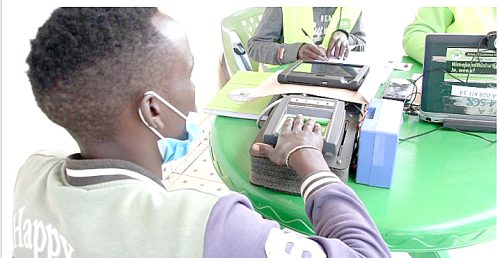
Upon presenting oneself to IEBC stations for transfer, and as part of curbing double registration and unauthorized transfers, the commission’s officer is first required to search through the system and ascertain if the voter is already captured or registered before proceeding.
Currently, as part of IEBC reforms, unlike the traditional method where there was a manual search in the system by the registering officer, now it is just an ID scan by the KIEMS tablet, and all voter details pop up automatically.
Author
Latest News







Advertisement
More on Insights