Advertisement
Matiang’i as consensus candidate: Will opposition ambitions align or clash?
Thursday 30th October, 2025 09:24 PM|

In a political landscape still reeling from the 2022 elections, the Jubilee Party’s endorsement of former Interior Cabinet Secretary Fred Matiang’i as its 2027 presidential flagbearer has ignited fresh speculation about the viability of a united opposition front against President William Ruto’s regime.
Announced on October 30, 2025, during a National Executive Council (NEC) meeting chaired virtually by former President Uhuru Kenyatta, the move positions Matiang’i as a potential consensus figure.
Yet, beneath the surface of welcoming statements lies a web of individual ambitions that could either forge a formidable alliance or fracture it irreparably. As opposition leaders grapple with a selection formula, the question looms: will egos yield to strategy, or will personal aspirations derail a collective bid to oust Ruto in the first round?
The endorsement came swiftly and decisively. Jubilee’s NEC, in a unanimous vote, accepted Matiang’i’s formal application, appointing him both deputy party leader and presidential nominee. Secretary-General Jeremiah Kioni, addressing a press conference at party headquarters, framed it as a strategic pivot.
You Might Also Like



“We have resolved that Matiang’i represents us at the United Opposition. On top of that, we have formally received his application to be the presidential candidate, and the NEC has approved and resolved that he now carries the flag of the Jubilee Party as the presidential candidate,” Kioni stated.
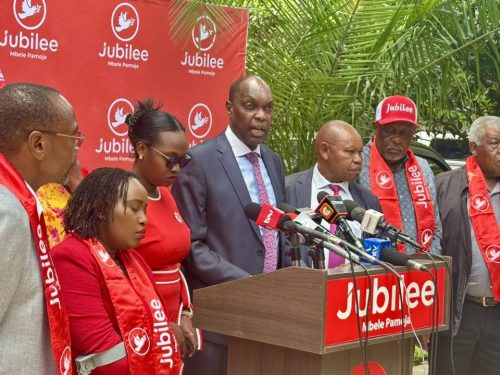
He emphasised Matiang’i’s role as the “face of the party moving forward,” especially given Kenyatta’s limited availability. This dual mandate empowers Matiang’i to negotiate within the broader opposition coalition, signalling Jubilee’s full-throated commitment to the anti-Ruto camp after months of ambiguity that left Kenyans questioning its alignment.
Matiang’i’s acceptance
Matiang’i wasted no time in embracing the nomination. In a post on X, he wrote, “I am deeply honoured by the Jubilee Party National Executive Committee’s unanimous acceptance of my formal application to be the Party’s presidential nominee. I am profoundly grateful for the opportunity to serve as Deputy Party Leader, and I graciously accept the Party’s nomination to serve as its representative within the United Opposition.”
Kioni described this initiative as a “comprehensive plan to revamp and re-energise the Jubilee Party,” aimed at “strengthening the party’s grassroots networks, rebuilding public confidence, and reaffirming Jubilee’s commitment to the values of unity, development, and democracy.”
This comes after the party’s post-2022 setbacks, when internal divisions and a perceived drift toward the government eroded its base. The response from allied parties has been cautiously optimistic, with hints of a brewing consensus.
Democracy for Citizens Party (DCP) Organising Secretary Peter Mbae hailed it as a positive step, stating, “As DCP and United Opposition, we welcome the nomination of Dr Fred Matiang’i as a presidential candidate. He joins the other candidates who will come up with a formula to achieve a convincing win during Round One.”
Navigating ambitions and historical precedents
Yet, Matiang’i’s path to consensus is fraught with historical precedents of clashing ambitions. Just a day prior, on October 29, 2025, he publicly reaffirmed his opposition credentials, stating, “While we might have personal differences and occasional disagreements, we share one common goal: to ensure that the current regime does not extend its rule beyond 2027.”
This echoes his defense of his political independence during a May 2, 2025, homecoming at Gusii Stadium, where he declared, “For ten years, I worked tirelessly for this country. I am known to be a good worker, and if given the chance, I am ready to work for Kenyans.”
Dismissing whispers of being Uhuru’s “project,” Matiang’i added, “There was no reason for me to abandon Jubilee, having worked under it for 10 years as a Cabinet Secretary. Those labelling me a project of the former president are, ironically, the same people seeking to engage with me behind closed doors.”
The United Opposition, encompassing Jubilee, DCP, DAP-K, and others, has shown flashes of coordination, as seen in the inaugural DCP-DAP-K joint rally in Malava, where former Kakamega Senator Cleophas Malala drew a mammoth crowd.
Jubilee’s pledge to “engage with other like-minded political formations to build a strong and united Kenya” further bolsters this narrative. Still, sceptics point to unresolved tensions.
Figures like Kalonzo Musyoka, Eugene Wamalwa, and Martha Karua have long nurtured their own presidential dreams, and past coalitions like Azimio la Umoja faltered on power-sharing disputes. Matiang’i’s technocratic appeal, rooted in his no-nonsense Interior tenure, may rally moderates, but it could clash with more populist voices demanding ideological purity.
Ultimately, Matiang’i’s elevation tests the opposition’s maturity. If ambitions align behind a fair process, it could consolidate a broad church capable of exploiting Ruto’s vulnerabilities on economic woes and governance.
But if they clash, as in 2022, fragmentation beckons, handing the incumbent an easy path. As Kioni put it, this is about “unity, development, and democracy.” The coming months will reveal whether rhetoric translates to reality, or if 2027 becomes another tale of squandered potential.
Author
Latest News




Advertisement
More on Insights