Key political events that shaped 2025
By Aloys Michael, December 24, 2025The year 2025 marked a significant chapter in global and national politics, defined by decisive moments that reshaped leadership, policy priorities, and public discourse.
Across the country, the government faced growing pressure to respond to economic uncertainty, security concerns, climate challenges, and shifting alliances.
Economic pressures, governance reforms, and questions of accountability dominated the national conversation, placing the government, opposition, and civil society under intense scrutiny.
Legislative actions on taxation, public spending, and governance reforms drew strong responses from Kenyans, while the judiciary played a central role in interpreting constitutional limits and protecting civil liberties.
Public demonstrations and civic activism highlighted a growing demand for transparency, inclusion, and responsible leadership.
Raila’s death
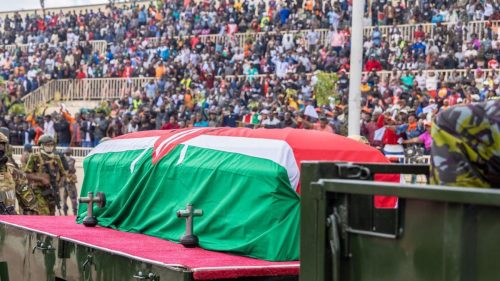
The death of veteran Kenyan politician and former Prime Minister Raila Odinga marked one of the most significant political moments of the year.
Odinga, long seen as a central figure in Kenya’s struggle for democratic reform, died at the age of 80 while undergoing treatment in India. He suffered a sudden cardiac arrest at a hospital in Kerala, and doctors were unable to save him.
President William Ruto hailed Odinga as a principled leader who shaped Kenya’s democracy, announcing seven days of mourning, half-mast flags, and a state funeral, as grief spread nationwide with mourners gathering in Kibera, Nairobi, and beyond.
Public viewings at Nairobi’s main stadium drew huge crowds but descended into unrest that left several dead and injured, before Odinga was laid to rest on October 19, 2025, following a state funeral with full military honours attended by thousands of Kenyans and foreign dignitaries, and a private burial in Kang’o Ka Jaramogi in Bondo, Siaya.
Oburu taking over ODM
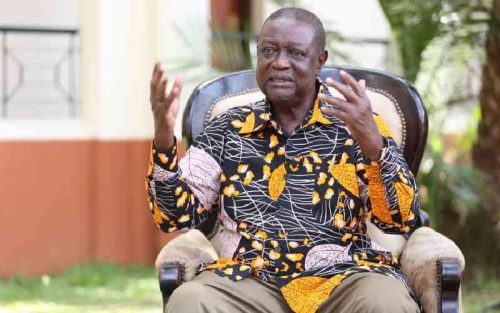
The appointment of Siaya Senator Oburu Oginga ended a brief period of uncertainty within the party and positioned him as the substantive leader ahead of the 2027 general election.
ODM’s National Executive Council (NEC) named Oburu Acting Party Leader, a day after Raila’s passing. He received strong backing from delegates in Nyanza counties, including Kisumu, Siaya, Migori, and Homa Bay, and his succession was formally endorsed on October 24, 2025. On October 27, 2025, he was confirmed as the new ODM Party leader.
The 10-point agenda
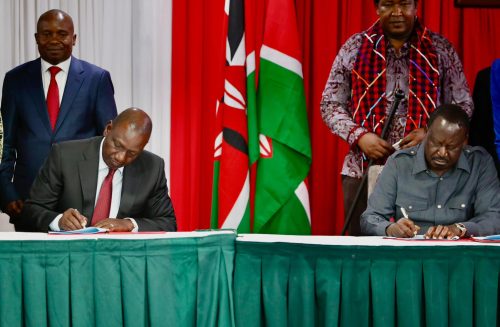
On March 7, 2025, at Nairobi’s KICC, President Ruto and Raila signed a Memorandum of Understanding committing their parties to a 10-Point Agenda. The pact aimed to create a broad-based framework for cooperation on Kenya’s socio-economic and governance challenges.
The agreement focused on governance reforms, including public sector accountability, devolution, youth empowerment, and fiscal discipline. Both leaders pledged to follow recommendations from the National Dialogue Committee (NADCO) report and promote inclusive decision-making.
Ruto described the pact as a step toward “credible, inclusive, and transparent governance,” while Raila Odinga called it a new chapter in bipartisan cooperation to strengthen the rule of law and citizens’ welfare.
After signing, the two leaders formed a five-member implementation committee to oversee the agenda, chaired by former Senator Agnes Zani and including representatives from UDA and ODM.

Gen Z protests
Building on Occupy Parliament 2024 protests, 2025 saw a surge of youth-led demonstrations across Kenya, driven by rising living costs, economic frustration, and allegations of police brutality.
Tensions peaked after the death of blogger and teacher Albert Ojwang in police custody, sparking outrage that intensified around Saba Saba Day in July.
The government responded with a harsh security crackdown, using live ammunition and tear gas, causing dozens of deaths and hundreds of injuries, drawing both domestic debate and international condemnation.

IEBC reconstitution
President William Ruto appointed a new leadership team at the Independent Electoral and Boundary Commission (IEBC) in mid-2025, ending over two years of institutional paralysis ahead of the 2027 General Election.
The appointments in June sparked a legal standoff after the High Court temporarily blocked the gazetting, but the President re-gazetted the names, allowing the officials to be sworn in on 11 July 11, 2025.
Erastus Edung Ethekon was named IEBC Chairperson, leading six commissioners: Ann Njeri Nderitu, Moses Alutalala Mukhwana, Mary Karen Sorobit, Hassan Noor Hassan, Francis Odhiambo Aduol, and Fahima Araphat Abdallah.
The reconstitution ended a leadership vacuum since 2023, allowing the commission to resume key activities like voter registration, boundary reviews, and by-election management.
Ruto-Gideon Moi truce
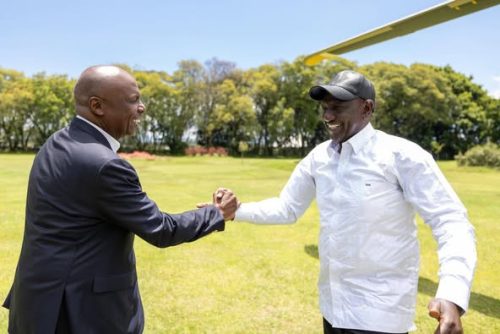
Ruto and Kenya Africana National Union (KANU) leader Gideon Moi announced a political alliance on October 10, 2025, aiming to foster national unity and cooperation ahead of the 2027 elections.
As part of the deal, Moi withdrew from the Baringo senatorial by-election to prevent political fragmentation, highlighting their coordinated strategy.
The alliance signals a shift toward coalition-building in Kenyan politics, though it faced criticism from KANU’s youth wing and a section of leaders, who called it a betrayal of the party’s founding principles.
By-election drama
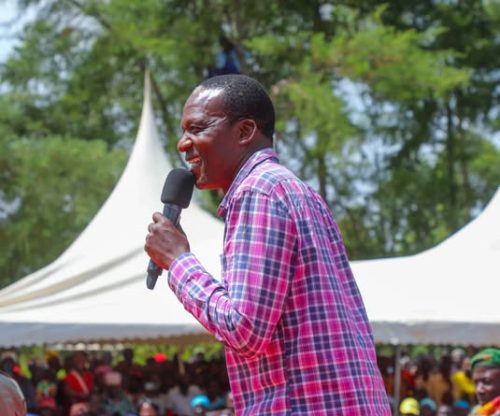
The 2025 by-elections were among the most closely watched political events in Kenya, covering key constituencies from Malava to Mbeere North.
These contests tested party alliances and the credibility of the newly reconstituted IEBC ahead of the 2027 general election.
In Malava, UDA retained its seat amid claims of voter intimidation and logistical challenges, drawing scrutiny from civil society groups and opposition parties.
Meanwhile, voter turnout in Mbeere North was unusually high, reflecting growing public engagement despite tense political rivalries.
Across other constituencies, the by-elections revealed persistent electoral challenges, including administrative delays, security concerns, and legal disputes, highlighting the need for continued reforms in Kenya’s electoral process ahead of 2027.