Justice or jitters: Kindiki’s renewed battle against Gachagua as 2027 clock ticks
By Kenneth Mwenda, May 16, 2026The court battle surrounding the impeachment of former Deputy President Rigathi Gachagua has grown into one of the most sensitive political and legal cases ahead of the 2027 General Election.
What began as a dispute over impeachment procedure has now expanded into a wider political question about the future of Deputy President Kithure Kindiki and his position in President William Ruto’s administration.
The latest developments in court have revived debate over whether Kindiki is simply defending his legal position or using procedural appeals to slow the case and protect his political future before the next election.
At the centre of the dispute is a medical affidavit sworn by Dr Daniel Gikonyo, founder of Karen Hospital. The affidavit supports Gachagua’s argument that his impeachment process violated constitutional rights because he was unwell during Senate proceedings in October 2024.
Gachagua maintains that he not only wants the court to find fault in the process. He wants the entire impeachment declared null and void. He also seeks full pay and benefits for the remainder of his term, arguing that his removal breached constitutional protections.
According to Dr Gikonyo, Gachagua arrived at hospital with severe chest pains linked to stress and required immediate observation and rest. His legal team argues that this condition prevented him from fully participating in the impeachment process.
Although this forms only part of the broader case, Kindiki’s legal team treated it as a major threat to the legitimacy of the impeachment record.
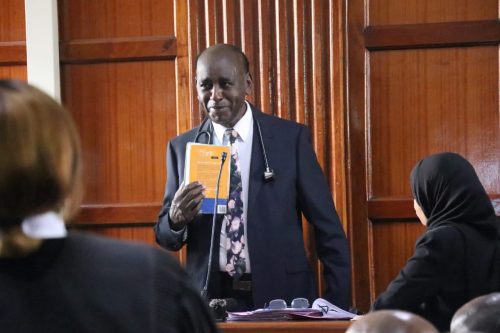
His lawyers, led by Senior Counsel Muthomi Thiankolu, pushed for cross-examination of the doctor. During the hearing, they questioned timing inconsistencies, hospital records and the use of initials instead of full names in medical documents.
However, Dr Gikonyo defended his testimony firmly in court.
“I am a doctor. I treat patients. I do not control their meetings or movements,” he said.
He also dismissed claims that Gachagua used hospital admission to avoid appearing before the Senate.
“My testimony is based on medical science and the patient I treated,” he added.
Court observers noted that the cross-examination did not significantly weaken the medical evidence, even though Kindiki’s legal team pressed the doctor for several hours.
Appeal against admissibility
The latest legal move came on May 16, 2026, when Kindiki filed a formal notice of appeal challenging the High Court’s decision to admit Dr Gikonyo’s affidavit into evidence.
The ruling had been delivered on May 7, 2026, by a three-judge bench comprising Justices Eric Ogola, Anthony Mrima and Fred Mugambi.
In his notice, Kindiki states that he is dissatisfied with the ruling and intends to challenge it at the Court of Appeal.
He argues that the court wrongly admitted the affidavit and its annexures as valid evidence in the case.
The notice reads in part:
“That Prof. Kithure Kindiki, the 2nd Interested Party herein, being dissatisfied with the Ruling delivered by this Honourable Court (Ogola, Mrima and Mugambi JJ.) on 07 May 2026, intends to appeal to the Court of Appeal against all such parts of the Ruling as found and held that the Affidavit sworn by Dr Daniel Kibuka Gikonyo together with the annexures thereto is admissible and duly filed and served.”
This appeal focuses on a narrow procedural issue, but its impact goes far beyond evidence law. The affidavit forms a key pillar in Gachagua’s argument that the impeachment process was unconstitutional.
High political stakes
Legal experts and political analysts say the medical affidavit could shape the final outcome of the entire case.
If the court eventually rules that the impeachment was unconstitutional, the decision could invalidate the process that removed Gachagua from office. That outcome would place immediate pressure on Kindiki’s position as deputy president.
Thiankolu captured this risk during submissions in court:
“If there was no impeachment, it means he remains in office, he never left office.” The legal effect of quashing that process would mean there was no impeachment at all.
Political tension ahead of 2027
Beyond the courtroom, political speculation continues to grow around Kindiki’s role in the 2027 election.
Some political insiders suggest that President Ruto may still reconsider his running mate, despite Kindiki’s current position and visibility in government. These claims are tied to shifting political alliances, especially in the Mount Kenya region, where Gachagua still retains strong influence.
Others argue that Ruto may prefer a different political balance to manage the regional tensions that followed the 2024 impeachment.
At the same time, Kindiki maintains strong public backing. A recent TIFA survey placed him as the most preferred candidate to deputise Ruto in 2027, far ahead of other possible contenders.
This creates a contradiction in political perception. Public support appears strong, but internal coalition politics remain uncertain.
If the court overturns the impeachment, the consequences could be far-reaching.
First, Gachagua could argue for restoration to office on the basis that the removal process lacked constitutional validity.
Second, the presidency could face a legal and political dilemma over how to manage two competing claims to the same office, depending on how the court frames its ruling.
Third, Kenya Kwanza’s political balance in Mount Kenya could shift sharply. Gachagua’s supporters already view the impeachment as unjust, and a court victory would strengthen that position ahead of the election.
Fourth, Kindiki could lose both political momentum and institutional advantage if removed from office before 2027, weakening his position in the national race.
Delay or defence?
Kindiki’s strategy now appears to focus on controlling the pace of litigation. By appealing procedural rulings and challenging the admissibility of evidence, his legal team extends the timeline of the case deeper into 2026.
Supporters say this is a standard legal defence. Critics argue it also creates political breathing space at a crucial moment.
What remains clear is that each delay keeps Kindiki in office longer, allowing him to consolidate influence while the court process continues.
The impeachment dispute has moved far beyond legal arguments over affidavits and timelines. It now sits at the centre of succession politics, coalition stability and constitutional interpretation.
Kindiki continues to defend his position in court. Gachagua continues to challenge the legality of his removal. And President Ruto remains politically exposed to whichever direction the court takes.