How UAE’s dramatic OPEC departure could affect Kenyan fuel costs
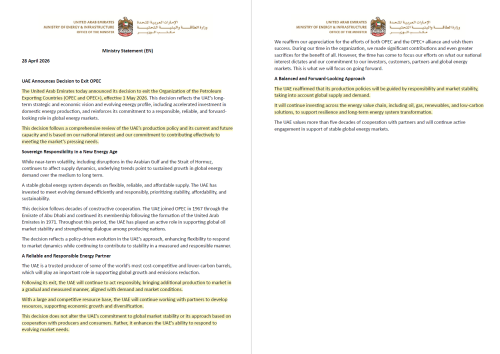
By Kenneth Mwenda, April 28, 2026The United Arab Emirates announced on Tuesday, April 28, 2026, that it will leave OPEC and OPEC+ with effect from May 1, 2026. The news comes from an official statement by the UAE Ministry of Energy and Infrastructure. This move hits the oil cartel hard, especially Saudi Arabia, at a time when fighting in Iran has already disrupted supplies through the Strait of Hormuz.
Kenya imports most of its refined fuel from the Gulf, including large volumes from Abu Dhabi National Oil Company (ADNOC) of the UAE. Any change in Gulf production or prices touches Kenyans directly at the pump, in transport costs, and in the price of food and goods.
Why the UAE left
The UAE joined OPEC in 1967 through Abu Dhabi and stayed after the country formed in 1971. In its statement, the ministry said the decision follows a full review of production policy and future capacity.
Officials pointed to the country’s long-term strategy, which includes more investment in oil, gas, renewables and low-carbon energy. They want greater flexibility to respond to market demand.
“This decision follows a comprehensive review of the UAE’s production policy and its current and future capacity and is based on our national interest and our commitment to contributing effectively to meeting the market’s pressing needs,” the statement reads.
The statement stresses that the UAE will keep acting as a reliable supplier. It plans to bring extra oil to market gradually, in line with demand, and will continue to work with partners. The country also thanked OPEC for past cooperation but said it must now put its national interests first.
The exit happens while Iranian attacks and threats have badly affected shipping through the Strait of Hormuz. This narrow waterway normally carries about one fifth of the world’s oil and gas. Disruptions have already pushed Brent crude above $110 a barrel in recent days. UAE’s departure could weaken OPEC’s ability to control supply in the longer term, because the country holds important spare capacity.
Some observers link the move to tensions inside the Gulf over how to handle the Iran conflict. The UAE has criticised the level of support from other Arab states.
For Kenya, the key question is whether the extra flexibility allows the UAE to produce and export more oil once shipping routes improve.
Direct effects on Kenya
Kenya’s Government-to-Government (G-to-G) fuel contracts with ADNOC, Saudi Aramco and ENOC will not be affected. These are separate bilateral agreements, not tied to OPEC quotas. The UAE has repeatedly stated it will continue acting as a reliable energy partner.
The existing deals, which run until 2028, should continue normally. Fuel still arrives at Kipevu Oil Terminal in Mombasa before moving through the Kenya Pipeline Company network to Nairobi, Nakuru, Eldoret and Kisumu, and then by road tanker to petrol stations.
However, Kenya remains heavily dependent on Gulf crude. Any rise in international prices quickly feeds into landed costs, taxes and pump prices.
Recent weeks showed how sensitive the system is. In early April, 2026, EPRA raised petrol and diesel prices sharply because of higher global costs and a weak shilling. Public anger followed.
The government then cut VAT on petroleum from 13 per cent to 8 per cent.
EPRA adjusted prices downwards slightly for the period to May 14. In Nairobi, super petrol now sells for around Ksh 197.60 per litre and diesel around Ksh 196.63. These figures still hurt matatu operators, boda boda riders, farmers and manufacturers.

If the UAE increases output outside OPEC quotas, global supply could rise once Hormuz disruptions ease. That would put downward pressure on prices. Energy experts say even a modest increase in barrels from the UAE would help import-dependent countries like Kenya.
“The UAE is a trusted producer of some of the world’s most cost-competitive and lower-carbon barrels, which will play an important role in supporting global growth and emissions reduction. Following its exit, the UAE will continue to act responsibly, bringing additional production to market in a gradual and measured manner, aligned with demand and market conditions,” the statement reads.
However, short-term risks remain. Further attacks in the Gulf could spike prices again. Kenya holds no large strategic reserve – only 15 to 21 days of commercial stocks – so any supply hiccup shows up fast at the pump.
Kenya remains exposed to global swings. The government has taken steps such as the VAT cut, release of funds to moderate prices, and keeping kerosene prices steady. But longer-term answers lie in faster local exploration, more renewables, and diversified import sources beyond the Gulf.
Markets will now watch how Saudi Arabia and the rest of OPEC respond. If the cartel loses cohesion, oil prices may become more volatile. For ordinary Kenyans, that means the price of fuel – and everything it moves – could swing again.